Thomas Paine Quotes
The Christian religion is a parody on the worship of the sun, in which they put a man called Christ in the place of the sun, and pay him the adoration originally payed to the sun.
Paine, Thomas. The Age of Reason. Printed by Barrois, 1794, p. 10.


This was Jefferson’s definition of Christianity. However, for orthodox Christians, this was insufficient as Jefferson did not believe in the Trinity or in the divinity of Jesus. Nor did he believe in the Biblical narrative of most historical events. He was a Christian in the sense that he thought the ethics and philosophy of Jesus was as good as he had seen. See {629222}. In this sense, a number of the Founding Fathers were “Deists” including Jefferson’s conservative rival, John Adams.

The Governor opposed Jews being allowed into the colony at all, but was overruled by the Dutch West India Company. He feared that this would set a precedent and then Catholics and other “dissenters” would come to New York. He then prohibited them from worshipping as Jews {35223} but was again overruled. He was a very unpopular Governor who himself was a Calvinist fundamentalist having been the son of a Calvinist minister and studied for the ministry himself. The company set the standard of religious tolerance and enforced it. See {611104}. The governor predicted the consequence and the precedent did indeed allow Catholics to come to New York and both Jews and Catholics have been significant New York population groups ever since.

While moderate Muslims interpret this sura as meaning that theologically, a belief in the divinity of Christ is inconsistent to Islam, extreme fundamentalists take this to indicate that Christians are heretics and should be executed in accordance with Sharia – Islamic Law.
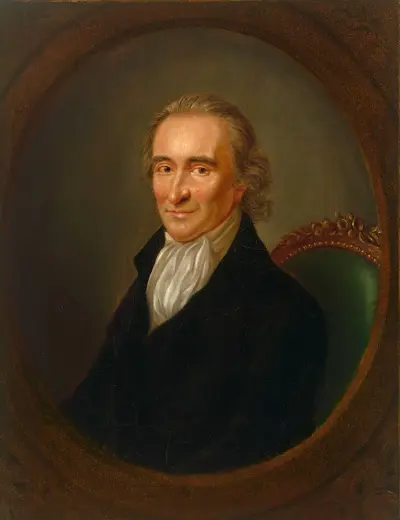
Thomas Paine was an English-born American political activist, philosopher, political theorist, and revolutionary. He authored Common Sense (1776) and The American Crisis (1776–1783), the two most influential pamphlets at the start of the American Revolution, and helped inspire the patriots in 1776 to declare independence from Great Britain. His ideas reflected Enlightenment-era ideals of transnational human rights. Historian Saul K. Padover described him as "a corsetmaker by trade, a journalist by profession, and a propagandist by inclination".
