Karl Marx Quotes
The capitalist knows that all commodities, however scurvy they may look, or however badly they may smell, are in faith and in truth money, inwardly circumcised Jews, and what is more, a wonderful means whereby out of money to make more money.
Marx, Karl. Capital: A Critique of Political Economy, Volume I. Translated by Samuel Moore and Edward Aveling, Progress Publishers, 1887, p. 107.


Executed by the English for his part in the Easter Uprising.


Statements like this caused some to believe him a Marxist, but see his quotation on Karl Marx -- {603061}.


Often referred to as “The Dean of Black Historians.”


Ironically, Fitzhugh who detested socialism, held this basic socialist principle. His solution however, was that the profits were necessary for society, and therefore slavery was the solution for Blacks AND whites.

Spengler argued that all left wing moverments and even revolutions function in the interests of money and the many interests always end up profiting from even the attacks on itself.

Marx believed that the system of capitalism if it succeeded would be forced to globalize. To him, globalization was an inevitable consequence of capitalism itself and purely national industries would be destroyed.


One of the contradictions of capitalism is that at many points in history capitalism has caused and/or contributed to great death and suffering. However, that same capitalism has led to the development of science, technology, agronomy, medicine and education which has saved and preserved millions of lives and raised the standard of living more than anything else.

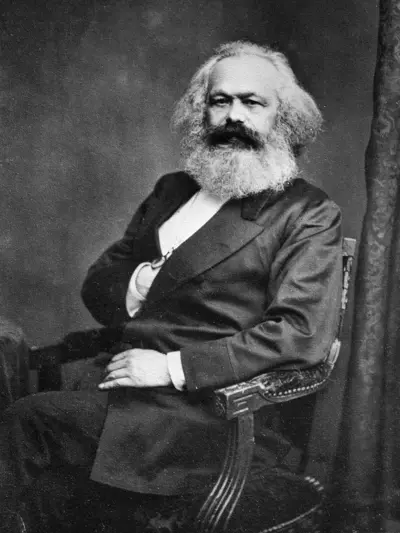
Karl Heinrich Marx was a German philosopher, economist, historian, sociologist, political theorist, journalist and socialist revolutionary. Born in Trier, Germany, Marx studied law and philosophy at university. He married Jenny von Westphalen in 1843. Due to his political publications, Marx became stateless and lived in exile with his wife and children in London for decades, where he continued to develop his thought in collaboration with German thinker Friedrich Engels and publish his writings, researching in the reading room of the British Museum. His best-known titles are the 1848 pamphlet The Communist Manifesto and the three-volume Das Kapital (1867–1883). Marx's political and philosophical thought had enormous influence on subsequent intellectual, economic and political history. His name has been used as an adjective, a noun, and a school of social theory.
