Tim Walz Quotes
The budgets we work on in Congress are more than just fiscal documents; they are a reflection of our moral values as well. In choosing where to spend money, members of Congress choose what priorities they value.
Walz, Tim. "Public Statements." Vote Smart, Just Facts.


This quotation pithily summarizes a common problem in politics of describing budgets. In most years there has been a national inflation. If a new budget is, in actual dollars, the same as the previous years or a little more, but the increase is less than the inflation level, the agency will not be able to provide the same level of services as the previous year. Therefore services will be cut and those who are politically in favor of more money for the program legitimately describe this as a “budget cut”. Opponents of larger funding increases, also legitimately describe the funding as a “budget increase”. One side refers to what the money can buy and the other, to the absolute dollars spent. This is an example of the classical ambiguity of political oratory.


In the non-defense side of the budget a very large proportion of the budget is for entitlements like Social Security and Mediacre which are obligations that must be paid. The remainder, the smaller part is everything else--funding the cabinet departments, all the medical and sdcientific research, all the federal aid to public dchools and police departments, all the welfare, foodstamp and other programs for the poor, the costs of the Federal COurt System, the White House, the Congress, the State Department, foreign aid, Homeland security, weatehr forcasting, all the agricultural programs, and viirtually everything the governmetn does. In 2017 President Donals Trump submitted a budget to COngress that increased defense spending by a fulll 10 percent, and gave a hugh tax cut for the wealthy and the corporations. To balance the budget, he propsoed eliminateing man of the existing progrms like "Meals on Wheels" which brings at least 1 hot meal a day to homebound poor eldertly people, and a host of other critical programs. He had no previous experience with a government budget which was thoudands of times larger and more complex than any budget he had ever seen. So many in Congress, in both partiesd, were very critical of the budget and Congress then started to create its own buget. This quote expressed the heart of the problem.


Although the Professor was often right about this technique, at the time he made this statement, the Clinton administration was actually cutting spending and using much of the revenue to pay for the deficit—just the opposite of what the Professor was worried about. It was successful and the deficit was eliminated and surpluses were projected. However the succeeding administration more closely followed the professor’s pattern and increased spending enormously for serious needs, but also cut taxes, so that we went during the Bush administration from the largest projected surplus in American history to the greatest deficit in American history.
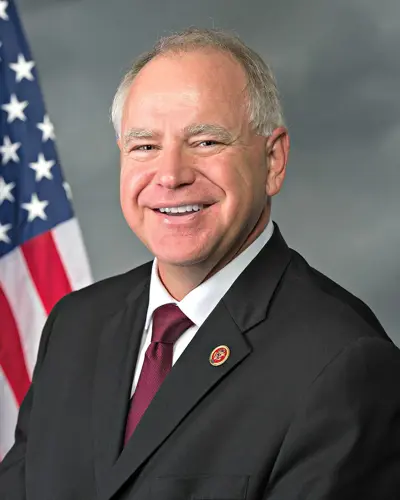
Timothy James Walz is an American politician and retired educator serving as the 41st governor of Minnesota since 2019. He is a member of the Democratic–Farmer–Labor Party (DFL).
