Gottfried Wilhelm Leibniz Quotes
Taking mathematics from the beginning of the world to the time when Newton lived, what he had done was much the better half.
Westfall, Richard S. Never at Rest: A Biography of Isaac Newton. Cambridge University Press, 1980, p. 600.


Napoleon recognized that technology and science were major factors in innovation and economic development and that mathematics was necessary for that and for economics, and therefore placed a great deal of emphasis on mathematics education. He was a fairly competent mathematically himself having been an artillery officer early in his career.


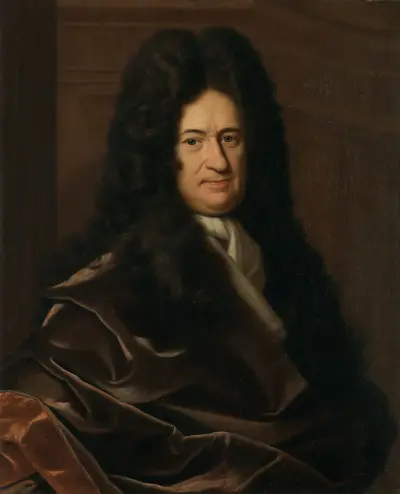
Gottfried Wilhelm (von) Leibniz was a prominent German polymath and one of the most important logicians, mathematicians and natural philosophers of the Enlightenment. As a representative of the seventeenth-century tradition of rationalism, Leibniz developed, as his most prominent accomplishment, the ideas of differential and integral calculus, independently of Isaac Newton's contemporaneous developments. Mathematical works have consistently favored Leibniz's notation as the conventional expression of calculus. It was only in the 20th century that Leibniz's law of continuity and transcendental law of homogeneity found mathematical implementation (by means of non-standard analysis). He became one of the most prolific inventors in the field of mechanical calculators. While working on adding automatic multiplication and division to Pascal's calculator, he was the first to describe a pinwheel calculator in 1685 and invented the Leibniz wheel, used in the arithmometer, the first mass-produced mechanical calculator. He also refined the binary number system, which is the foundation of nearly all digital (electronic, solid-state, discrete logic) computers, including the Von Neumann machine, which is the standard design paradigm, or "computer architecture", followed from the second half of the 20th century, and into the 21st.
