Ernest Hemingway Quotes
Shooting gives me a good feeling. It is faster than baseball and you are out on one strike.
Hemingway, Ernest. Quoted in Lillian Ross, "How Do You Like It Now, Gentlemen?" The New Yorker, 13 May 1950.


The great cowboy gunslinger was much a myth in that the few that were very good shots became legends. The best shots in America generally were the hunters of small game like Annie Oakley and the military and sportsmen who studied the gun and practiced endlessly. Almost all were in the Midwest and East. In the case of Oakley, she learned to shoot small game for food in rural Ohio. Her first shooting contest was not on the frontier but in the big city of Cincinnati.
This is yet another quotation demonstrating that the image of early America as a gun culture where most men were armed, skilled with those arms, and ready to come to the defense of the country. It turns out that none of the three corresponded to any historical reality for most Americans.

This historical quotation gives us an interesting picture or Secret Service practices and First Family Security in 1937. Unlike all the first ladies before her and most after her, she was a very active political figure and regularly received threats. Yet she not only drove alone on occasions, but published that fact to the world in this column. Also, although an extreme liberal, she had little trouble carrying a gun and learning to use it. Her father and her Uncle Theodore Roosevelt both were very comfortable with guns. What is surprising is that the Secret Service did not provide more protection for her. At that time gun ownership had not yet become a political issue, and Mrs. Roosevelt, a committed liberal, thought nothing of “packing heat” at a personal level.


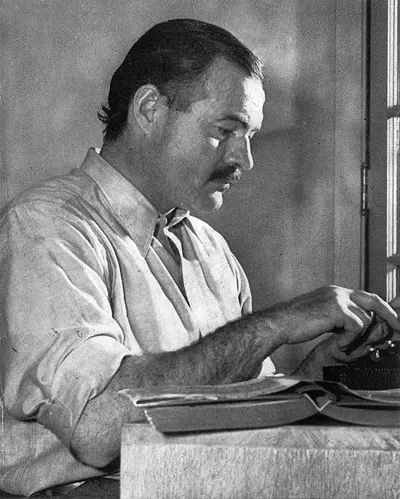
Ernest Miller Hemingway was an American novelist, short-story writer, journalist, and sportsman. His economical and understated style—which he termed the iceberg theory—had a strong influence on 20th-century fiction, while his adventurous lifestyle and his public image brought him admiration from later generations. Hemingway produced most of his work between the mid-1920s and the mid-1950s, and he was awarded the Nobel Prize in Literature in 1954. He published seven novels, six short-story collections, and two nonfiction works. Three of his novels, four short-story collections, and three nonfiction works were published posthumously. Many of his works are considered classics of American literature.
