Basil I Quotes
She who purposely destroys the fetus, shall suffer the punishment of murder… Those who give drugs for procuring abortion, and those who receive poisons to kill the foetus, are subjected to the same penalty as murder
Basil the Great
Basil I, ?-886, Byzantine Emperor, Book of Statutes
Sourced by: Eigen's Political and Historical Quotations


In most parts of the country, if the legislators did not carve out the exceptions for rape incest and danger to the life of the mother, they would lose the majority of their support as most Americans who oppose the freedom of abortion that existed after Roe v. Wade, but really do not view abortion in the early trimester as murder. They just think that the regulation should be greater than it is.

This is an example of a twisted kind of political logic that says that if there are law breakers who don't like legal behavior of others and will therefore commit violent crimes if they continue to act legally, the law should be changed to make the behavior illegal so they criminals and murderers will not be so angry. However, there are few people who actually believe this. An ironic thing about this man is that his rabid opposition to abortion is based on his interpretation of the Bible (Old Testament) which never mentions abortion as a crime. (The Early Hebrews and Christians practiced abortion and saw no Biblical stricture against it.) However, he claims that the Biblical crime of bestiality—punishable by death—should be normalized. See {583375} for an example of this hypocrisy.

This is the earliest surviving attempt of the Romans to formulate a legal code.

Churches are political organizations too and are subject to the forces of their membership. In the case of the Southern Baptist Convention in 1971 they passed resolutions to assure the right of a woman to have an abortion to protect her health. The position on abortion changed steadily thereafter to even pass Constitutional amendments to ban abortions except to save the life of the mother. See {614356},54122, {614358}, {614359}, {614360}, {614361} for the dynamic history of the change.
Churches are political organizations too and are subject to the forces of their membership. In the case of the Southern Baptist Convention in 1971 they passed resolutions to assure the right of a woman to have an abortion to protect her health. The position on abortion changed steadily thereafter to even pass Constitutional amendments to ban abortions except to save the life of the mother. See {614356},54122, {614358}, {614359}, {614360}, {614361} for the dynamic history of the change.

This was the traditional Jewish view of abortion and infanticide. It is the view of the Orthodox Jews of today, but the larger body of Reform Jews, like many Protestant sects, do not equate abortion to murder or infanticide.


At the time, condoms and other forms of contraceptives were illegal to buy, sell, possess or own. As late as 1963 a Connecticut druggist was sentenced to jail for filling a doctor’s prescription for condoms and selling them to a married couple even thought the woman might die if she again became pregnant. The Supreme Court (Griswald v. Connecticut) established that a woman had a right to control her own reproductive cycle and the government had no business interfering with a privacy right possessed by a couple. Roe v. Wade established the right to an abortion. The same moral compunctions used with abortion were, and still are used by some to oppose any form of artificial birth control. They argued: preventing a life was as serious a moral failure as taking one. Many Catholics, many evangelical and fundamentalist protestants, and some orthodox Muslims are today morally opposed to birth control and believe that the government should ban birth control as it once was in the United States.


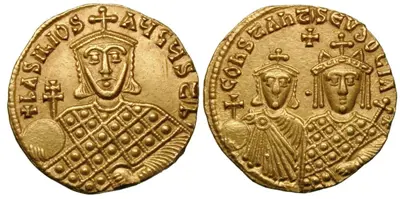
Basil I, called the Macedonian, was a Byzantine Emperor who reigned from 867 to 886. Born a simple peasant in the theme of Macedonia, he rose in the Imperial court. He entered into the service of Theophilitzes, a relative of Emperor Michael III (r. 842–867), and was given a fortune by the wealthy Danielis. He gained the favour of Michael III, whose mistress he married on the emperor's orders, and was proclaimed co-emperor in 866. He ordered the assassination of Michael the next year. Despite his humble origins, he showed great ability in running the affairs of state. He was the founder of the Macedonian dynasty. He was succeeded upon his death by his son (perhaps actually Michael III's son) Leo VI.
