Christopher Hitchens Quotes
Ronald Reagan said that he sought a Star Wars defense only in order to share the technology with the tyrants of the U.S.S.R.
Hitchens, Christopher. For the Sake of Argument: Essays and Minority Reports. Verso, 1993.


3 days later, President Truman, announced that the Russians had successfully developed an atomic weapon. This quotation gives us another example where the Central Intelligence Agency failed to predict and/or warn America about a crucial event. Others included the North Korean invasion of South Korea, the Arab Spring, the Soviet invasion of Afghanistan, the fall of the Berlin wall, and the collapse of the Soviet Union.

McNamara stated that the Cuban Missile Crisis was more politically required than defense required. The Russians had nuclear missiles at the time that could reach the United States and didn’t really need missiles in Cuba to threaten America. Public opinion and the Republican Political doctrine persuaded President Kennedy that independent of safety and military factors, nuclear missiles in Cuba was a major political problem. See his comment to the President and the Other Officials dealing with the crises—{631968}.

In 1992 Russia was in terrible economic shape after the fall of the Soviet Union. Keeping up with the United States military expenditures had bankrupted the Russians. The United States which had strategically increased its defense spending to break the Russian economy if they tried to keep up. However, the U. S. expenditures had forced America into a deficit spending period which produced a national deficit greater than all the previous cumulative deficits in our history. So the American economy was not in great shape either. Meanwhile, Japan, whose constitution (imposed by America after WWII) forbade having a military and funding a military. The result was the Japanese economy was growing at a much more rapid rate, and did not have the unbalanced budget of the United States and Russia. Hence, Tsongas’ observation.


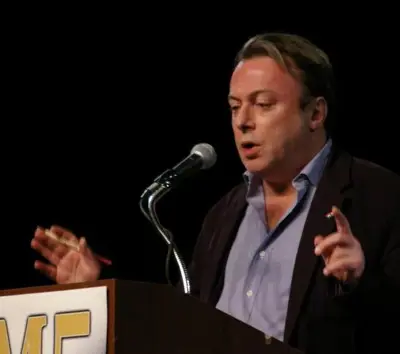
Christopher Eric Hitchens was an English-American intellectual, polemicist, and socio-political critic, who expressed himself as an author, orator, essayist and columnist. He wrote, co-wrote, edited or co-edited over 30 books, including five of essays on culture, politics and literature. Having contributed to several publications, he is broadly regarded as one of the most influential atheists of all time.
