Charles Spurgeon Quotes
Purposes, plans, and achievements of men may all disappear like yon cloud upon the mountain's summit; but, like the mountain itself, the things which are of God shall stand fast for ever and ever.
Spurgeon, Charles H. The Treasury of David. Vol. 1, Passmore & Alabaster, 1870, p. 320.

Bahaullah, the Bahai founder, sent letters to the Queen and most of the other major rulers of the world. Only Victoria responded positively. The Bahai believe that as a result Victoria, who came to the throne when most Englishmen felt that she would be the last British monarch, went on to rule for more than 60 years, the longest in history. All the other recipients who ignored their letter including Napoleon, the Pope, the Czar—all came to a relatively rapid end of their reign. Many Bahai believe this was divine will at work.


His concept of the devine however was quite different and much more abstract than the Rabbis, Priests and Imams of the time. Albert Einstein, was a religious Jew, but his view of God was that of Spinoza (See Quotation 631763) who had been excommunicated by the Jews. Spinoza’s ideas were considered so radical and dangerous that he was the only man in history who was excommunicated by the Catholics, the Jews and the Muslims. Spinoza did not believe in a kins of anthropromorphic God who fabricated the earth and the stars. He saw God in the devine nature of the earth and the heavens and the mathematical rules that govern everything. It was this abstraction that was Spinoza's God which made sense to Einstein. Got was in the order, physical laws and mathematics of the universe. Modern scientists who are religious have no difficulty with the probablsitic nature of much of the physics that governs the univrese. It was God who created or more abstractly, was the mathematical and physical laws that in turn allowed the universe to be created from nothing.

Huckabee, a fundamentalist Christian Minister in addition to being a politician, had been very tolerant of other religions and their rights. However, on the abortion question he seemed to be calling for a Constitutional amendment to make abortion illegal. The likelihood of passing such a Constitutional Amendment given the supermajority requirement was very low given the national division on this polarizing issue. A very careful reading of the candidate’s statement shows that he never literally advocated an amendment. He just stated that is would be easier to change the Constitution than to change the world of God which to believers was immutable. Thus his statement was true, yet some interpreted it as a very clever way of making a moral statement without committing to a course of action that would deny women the right to make decisions over the use and risks to their own bodies, souls, and lives.


There are many scientists who disagree with Johnson’s very unusual logic. They point out that it is certainly possible that God initially did not have had humans in minds, and when they evolved, decided that they were worthy of salvation history and then interfered to the extent of a virgin birth. Others would point out that just because man cannot exactly foresee the exact future pattern of evolution, does not men that a Supreme Being could not have initiated the mechanism that he/she knew would result in salvation history. The Pope and the Catholic Church see no inconsistency between Darwinism and the salvation history. Then there are those non-Christians who do not believe that God ever did introduce salvation and there are many more of them than there are Christians. Then, it is possible that God just set things in motion and had more important things then micromanaging evolution on our one planet in a universe of billions of billions. Last there are those who do not believe that there is or has been a God. Of course there is the possibility that Johnson is right, and religiously he may be, but that is not subject to scientific analysis.
There is biblical prophesy that the Jews shall return to the Holy Land.
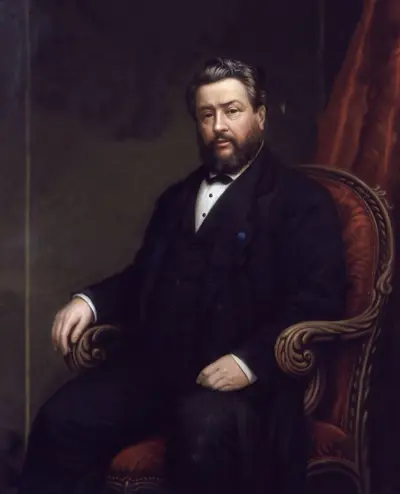
Charles Haddon Spurgeon was an English Particular Baptist preacher. Spurgeon remains highly influential among Christians of various denominations, among whom he is known as the "Prince of Preachers". He was a strong figure in the Reformed Baptist tradition, defending the 1689 London Baptist Confession of Faith, and opposing the liberal and pragmatic theological tendencies in the Church of his day.
