John Major Quotes
Prime Minister’s Question time is very different from anything in America. It is something that fortunately your President does not have to face.
John Major, British Prime Minister (Conservative), C-SPAN, Washington Journal, November 25, 1999
Sourced by: Eigen's Political and Historical Quotations

In the Canadian, British and some other Parliamentary systems of government, the Prime Minister must appear weekly or periodically in the House of Commons and be subjected to any questions that are asked. He/she cannot claim Executive Privilege or simply not answer questions as in the American Presidential System.


In 1875 Benjamin Disraeli had an opportunity to purchase the Suez Canal for Great Britain from the Khedive of Egypt who was in great need of cash. However, Disraeli had to act very fast and there was no way to quickly move an appropriation of the then very large sum of 4 million pounds through Parliament. So he sent Corry to ask Lionel Rothchild, the British financier, for a loan until the government might raise the money. Rothchild asked, what would be the security for such a large loan. Rothchild immediately gave the loan.


1st Earl of Oxford. Technically the title of Prime Minister was then non-existent, but he performed the function. Unlike America where the Chief Executive is elected for fixed 4 year terms, in England and other parliamentary democracies, if the Prime Minister cannot command a majority of the Praliament, he has to call new elections. Even if he cannot maintain the majority of his own party, he can be replaced by a simple vote of the members of the parliament of his own party. Margaret Thatcher for example, was never defeated at the polls in an election. She was thrown out of office by her own party.

Actually, Queen Elisabeth II, at that time the Queen of England, was very sophisticated about the policies of the nation. Chomsky’s point was not that the Queen was ignorant; it was that her role is ceremonial and it is not critical or even material that the monarch in a Constitutional Democracy understands or approves of the government program that is being presented.


1st Earl of Beaconsfield

In the British Constitutional Monarchy of the Victorian Era, the Queen still possessed enormous power and many in Parliament was constantly trying to have Parliament assume many of the Queen’s powers. The Prime Minister was in an awkward position. On the one hand, he was the Queen’s Prime Minister and leader of HER government. At the same time he was the leader of the political party that had won the last Parliamentary election. His party was trying to usurp some of the Queen’s powers and Peel explained to the Queen’s assistant that he would generally side with the Queen against his own party. It is doubtful that Anson and the Queen believed Peel on this point as his position as Prime Minister depended not on his being elected by the voters but by his party members of Parliament. In modern times, the British monarch has few real powers but is still very influential so there are no struggles over power with Parliament.


He had won election 3 times and had served 10 years.

At that time the king not only called Parliament into session but terminated the session and set the agenda. In this case, Charles I didn't want royal activities regarding taxation to be debated much less legislated upon. As the speaker rose to leave the chair, he was forcibly held in place by two members as the house voted by acclamation to condemn the taxes and even the merchants who paid them. This was perhaps the first legislative tax revolt in history.


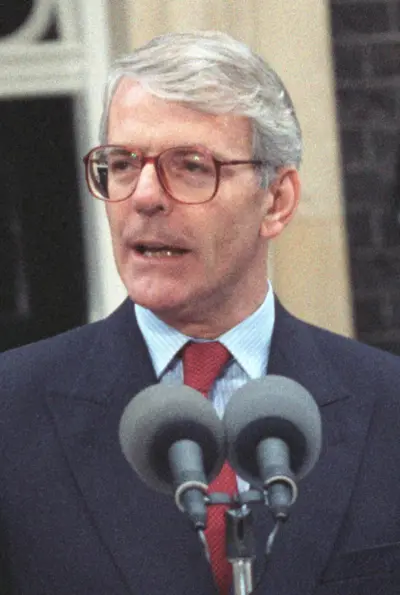
Sir John Major KG CH is a British politician who served as Prime Minister of the United Kingdom and Leader of the Conservative Party from 1990 to 1997. Major served in the Thatcher government from 1987 to 1990 as Chancellor of the Exchequer and Foreign Secretary, and was Member of Parliament (MP) for Huntingdon, formerly Huntingdonshire, from 1979 to 2001.
