Ignatius of Antioch Quotes
Our task is not one of producing persuasive propaganda; Christianity shows its greatness when it is hated by the world.
Ignatius of Antioch. "Epistle to the Romans." The Apostolic Fathers: Greek Texts and English Translations, edited and translated by Michael W. Holmes, 3rd ed., Baker Academic, 2007, ch. 3.


Plunckett was the last Roman Catholic martyr to be executed in Britain. He was accused of conspiring against the state by allegedly plotting to bring 20,000 French soldiers into the country, and for levying a tax on his clergy to support 70,000 men for rebellion. The English have always feared ever since Henry VIII severed England from the Roman Catholic Church, that the Papacy was plotting to restore Catholicism to England and sponsor an invasion of Ireland. And indeed that was true in several cases, but nowhere near as many as the English imagined. In this case, paranoia prevailed, and the trial was pretty much a farce, but he was convicted and sentenced to be hanged, drawn and quartered which he was.


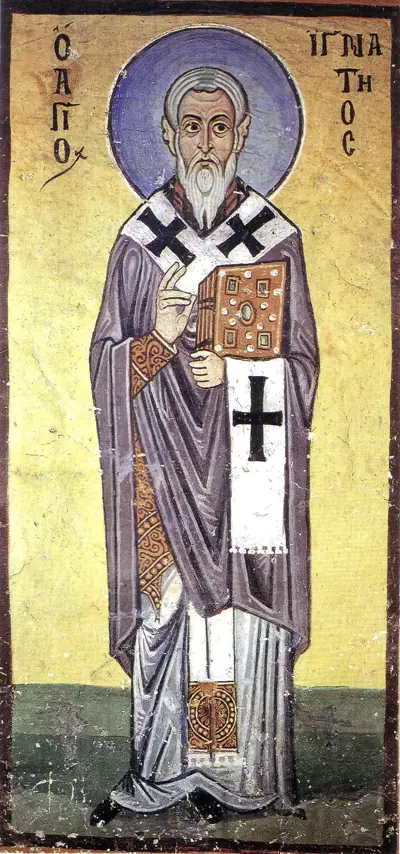
Ignatius of Antioch (/ɪɡˈneɪʃəs/; Greek: Ἰγνάτιος Ἀντιοχείας, Ignátios Antiokheías; died c. 108/140 AD), also known as Ignatius Theophorus (Ἰγνάτιος ὁ Θεοφόρος, Ignátios ho Theophóros, lit. "the God-bearing"), was an early Christian writer and bishop of Antioch. While en route to Rome, where he met his martyrdom, Ignatius wrote a series of letters. This correspondence now forms a central part of a later collection of works known to be authored by the Apostolic Fathers. He is considered to be one of the three most important of these, together with Clement of Rome and Polycarp. His letters also serve as an example of early Christian theology. Important topics they address include ecclesiology, the sacraments, and the role of bishops.
