Fela Kuti Quotes
Our prisons are very bad. When I was in Ikoyi prison, people were dying every day. They were carrying bodies out of the prison every day.
Moore, Carlos. Fela: This Bitch of a Life. Lawrence Hill Books, 2009.


Russia, under the Czar, had a brutal criminal justice system where criminals—often with their families—were forced across Russia to Siberia and Sakhalin. Stalin and the Communists did not invent the Gulag concept but then, although total enemies of the Czar and everything he stood for, emulated the worst of Czarist policies to deal with the Russian “enemies” of the state. The reference to “red-nosed prison supervisors” was to the image of the alcoholism that was (and still is) rampant among so many Russians—especially the prison supervisors who themselves were exiled to the harshest and remotest parts of the nation. They were notoriously heavy drinkers even be Russian standards.


Leary was a strong advocate of the use of illicit drugs and stimulants. Yet he ignored all the side effects and negative health consequences of the processes and while he thought he was assisting people to enlarge their mental horizons, he irresponsibly and criminally damaged many permanently. His government “persecutors” themselves were also all disgraced by the extremes to which they went to prevent the counter-culture characterized by Leary and others. They became paramoid that the drug culture would morph into a protest culture against the administration. The tended to exxagerate the negative consequences of illicit drugs--especially marijuana. These exaggerations caused many people to believe Leary and others who went to the other extreme and underated the negative consequences of illicit drugs. It became a culture war when it should have been a medical problem.

The Judge’s reference was to the Justice Department behavior at the trial of a group of radicals in Boston.

Reference to radical Islamic soldiers in the U.S. military:

Jarrett was testifying against Chinese immigrant laborers. The fact that they had a much lower standard of living meant that they would work for very small wages and would drive down the wages of existing white laborers. President Arthur withdrew Jarett’s nomination when he discovered that Jarett had been very critical of his administration.


Khanenei failed to make three important distinctions. First, the crimes committed by American forces in Abu Ghraib and Guantanamo were NOT the policy of the American government whereas all of Hitler’s crimes were not only government policy but Hitler had laws passed to enable these atrocities. Bush and the American Military command may have not been competent enough to prevent the problems, and may have been too lenient to punish the guilty, but they never intended them to occur. Second is scale. Abu Ghraib and Guantanamo illegalities led at most to the deaths of one or two people. Hitler killed over 6 million in his prisons. Third, as soon as Bush found out about the problems, they were stopped whereas Hitler continued until militarily removed from power and neutralized.

Abu Ghraib was the major prison in Iraq during the Iraq War. American military committed many crimes on prisoners ranging from murder to sexual humiliation. The actual perpetrators claimed that the higher ranks of officers knew what was ongoing and provided the policies, rules and culture of the prison. The president and the Vice President many thought were the officers responsible and violated the Uniform Code of Military Justice. Their administration had issued a legal memorandum that for the first time in American history would allow some kinds of torture of prisoners in the War on Terror. A few enlisted personnel were punished and a general was transferred but no senior military or civilian personnel were held responsible or punished.

84 people died after hundreds of peaceful Muslim protestors were crowded into Thai Army trucks and kept there for hours.


This was his reaction when he was criticized for encouraging over 1000 extrajudicial murders of accused drug addicts and drug dealers with no trial at all and no due process.


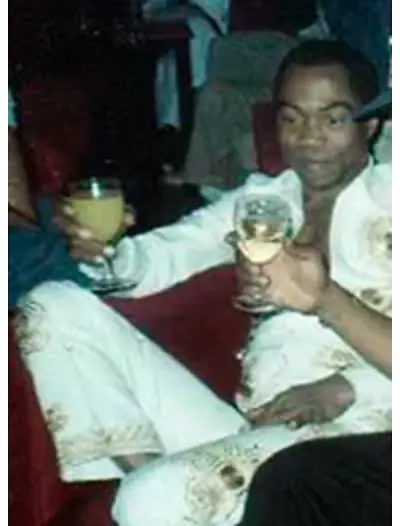
Fela Anikulapo Kuti was a Nigerian multi-instrumentalist, bandleader, composer, political activist, and Pan-Africanist. He is regarded as the pioneer of Afrobeat, an African music genre that combines traditional Yoruba and Afro-Cuban music with funk and jazz. At the height of his popularity, he was referred to as one of Africa's most "challenging and charismatic music performers". AllMusic described him as a "musical and sociopolitical voice" of international significance.
