Robert Moses Quotes
Our overbuilt cities with their congestion, their trend to high office buildings and apartments, their complete indifference to the most elementary principles of civilian defense, their slums representing past neglect and greed, can to a considerable extent be rebuilt on better principles if we are smart enough to look the facts in the eye and brush off the Babbitts who hold that wherever the dirt flies there is progress. On the other hand, cities can not be revolutionized and turned into garden villages or green belts. In the suburbs and near-by country, however, we still have a chance to do the right thing without stultifying compromises....
Moses became the greatest “builder” the world had ever known. The Bridges and tunnels into New York, the highways in the city and Long Island, the development of Fire Island and the World Trade Center were all his work. Babbitt was a very large building and construction contractor. The Cold War was ongoing and his reference to civilian defense was an absurd notion of the 1950s that building bomb shelters in cities and homes could protect the civilian population in the event of nuclear attack. This was actually an official government position and program.
Robert Moses, 1888-1981, Chairman, New York Port Authority, New York Gubernatorial Candidate (Republican), “Build and Be Damned", The Atlantic Monthly, December 1950
Sourced by: Eigen's Political and Historical Quotations

This quotation is notable because it illustrates some of the ideas about cities that were suggested at the time. The growth of the suburbs was the largest of the changes that actually tool place.


Roosevelt thought like Jefferson that it was not desirable to have a large proportion of the population residing in cities, and one of the more successful aspects of the New Deal with the improvement of conditions in rural America. Despite that, the trend to the cities was inexorable in America with the rest of the world following that trend.


Nations come and go—are born and die, but generally the cities remain as part of the new state or empire.


In most of the world there has been a continual migration into cities.
Cahokia was a very large Native American city just across the Mississippi River from St. Louis. In 1250, its population was about 15,000, comparable to that of London or Paris during the same period. At the time of the American Revolution, it was larger than New York, Boston of Philadelphia having 40,000 inhabitants at its peak. Tiahuanaco was a large city—30,000 at its peak—in Bolivia. The very ability to create and sustain such large communities shows that the Indians of the Americas were not simply hunter-gatherers but were very sophisticated in manipulating their environment and organizing large numbers of people.


Howard was one of the first people to recognize the migration from the country to the cities brought about by the Industrial Revolution and then suggest solutions. He advocated planned suburban communities that had some elements of the country, but allowed a density of people to function in an industrial economy. He called them “Garden Cities”. Forest Hills in New York and other American planned communities were much influenced by his thinking as were many other new communities since.
Describing the post WWII real estate and housing boom.


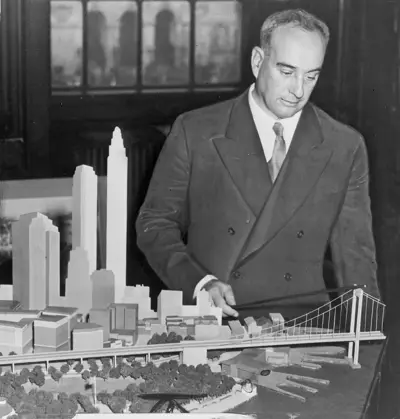
Robert Moses was an American public official who worked mainly in the New York metropolitan area. Known as the "master builder" of mid-20th century New York City, Long Island, Rockland County, and Westchester County, he is sometimes compared to Baron Haussmann of Second Empire Paris, and was one of the most polarizing figures in the history of United States urban development. His decisions favoring highways over public transit helped create the modern suburbs of Long Island. Although he was not a trained civil engineer, Moses's programs and designs influenced a generation of engineers, architects, and urban planners nationwide.
