James E. Webb Quotes
Our attainments [in space] are a major element in the competition between the Soviet system and our own . . . . in this sense, [they] are part of the battle along the fluid front of the cold war.
Webb, James E., and Robert S. McNamara. "Recommendations for Our National Space Program: Changes, Policies, Goals." 8 May 1961. Exploring the Unknown: Selected Documents in the History of the U.S. Civil Space Program, Volume I: Organizing for Exploration, edited by John M. Logsdon, NASA, 1995, p. 444.


Addressing his opponent, Richard Nixon:

Dr. Snyder was the youngest physicist at Los Alamos working on the Atom Bomb Manhattan Project. His rocketry skill was used to fire probes into the highly radioactive area to obtain samples and measurements immediately after the test bomb was exploded.

This was the first vehicle to be landed on a space object. On November 10, 1970, it was landed on the moon. It navigated, controlled by a driver on earth, for 9 months, sent back 22,000 pictures and conducted over 500 scientific experiments. A second was later landed also. It would be more than 20 years later that the United States developed and landed a rover vehicle on Mars. Lunokhod in Russian means “moon walker.” After the collapse of the Soviet Union, some of the Russian engineers who developed Lunokhod helped the U. S. scientists develop the Moon Rover.
It missed the moon and became the first manmade object to go into orbit around the sun just like a planet. Actually Lunik made some very valuable scientific measurements of the Van Allen Belt and other aspects of space. To deemphasize the miss of the moon, the Russians renamed the satellite as “Mechta”—The Dream.


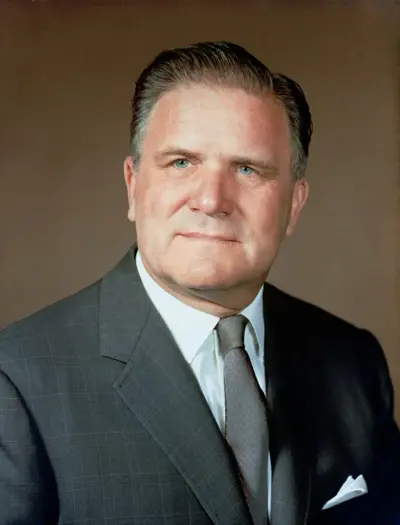
James Edwin Webb was an American government official who served as the second administrator of NASA from February 14, 1961 to October 7, 1968.
