Arthur C. Clarke Quotes
One orbit, with a radius of 42,000 kilometers, has a period of exactly 24 hours. A body in such an orbit, if its plane coincided with that of the Earth's equator, would revolve with the Earth and would thus be stationary above the same spot on the planet. It would remain fixed in the sky of a whole hemisphere ... [to] provide coverage to half the globe, and for a world service three would be required, though more could be readily utilized. (1945) [Predidicting geosynchronous communication satellites]
Clarke, Arthur C. "Extra-Terrestrial Relays: Can Rocket Stations Give World-wide Radio Coverage?" Wireless World, vol. 51, no. 10, Oct. 1945, pp. 305-308.


Medaris then told him to do it in 90 days to give him some slack. 80 days later the U. S. put its first satellite in orbit with a Jupiter Rocket. There were scientists at the Jet Propulsion Laboratory who had been experimenting with rocket recovery, who realized that they had enough power and technique to escape the Earth’s gravity and put an object in orbit. The asked for permission to do so on their next weekly firing and were refused. Two months later, the Russians put Sputnick in orbit.


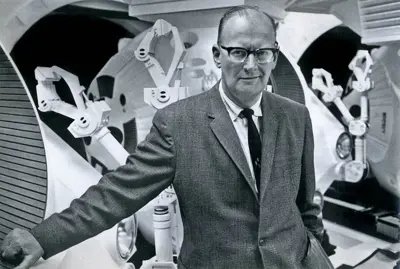
Sir Arthur Charles Clarke CBE FRAS was an English science-fiction writer, science writer, futurist, inventor, undersea explorer, and television series host.
