Aristotle Quotes
One can aim at honor both as one ought, and more than one ought, and less than one ought. He whose craving for honor is excessive is said to be ambitious, and he who is deficient in this respect unambitious; while he who observes the mean has no peculiar name.
Aristotle. Nicomachean Ethics. Translated by H. Rackham, Harvard University Press, 1926, p. 99.


Barry Goldwater's quotation repudiating this principle was one of the critical points of the presidential campaign of 1964.


Adams liked hardly anyone. Hamilton was a fellow Federalist leader. Adams even had harsh words for George Washington. See {621581}
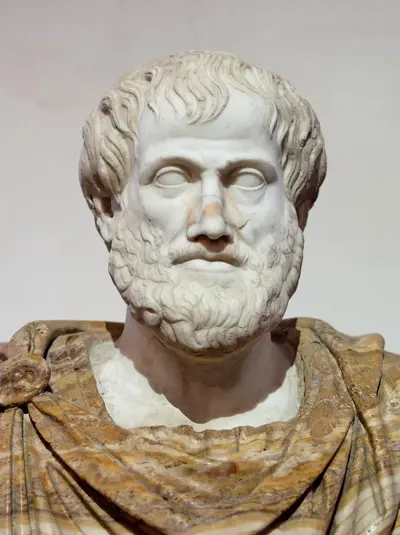
Aristotle (/ærɪˈstɒtəl/; Greek: Ἀριστοτέλης Aristotélēs, pronounced [aristotélɛːs]; 384–322 BC) was a Greek philosopher and polymath during the Classical period in Ancient Greece. Taught by Plato, he was the founder of the Lyceum, the Peripatetic school of philosophy, and the Aristotelian tradition. His writings cover many subjects including physics, biology, zoology, metaphysics, logic, ethics, aesthetics, poetry, theatre, music, rhetoric, psychology, linguistics, economics, politics, meteorology, geology and government. Aristotle provided a complex synthesis of the various philosophies existing prior to him. It was above all from his teachings that the West inherited its intellectual lexicon, as well as problems and methods of inquiry. As a result, his philosophy has exerted a unique influence on almost every form of knowledge in the West and it continues to be a subject of contemporary philosophical discussion.
