Zygmunt Bauman Quotes
Once we realize that the strangers are here forever and won't go away, then, like husband and wife in the old-style marriage, we would try to find a way of living together peacefully and with mutual benefit. The sooner we understand that in a globalized world the diasporic nature of cohabitation is never likely to end, that it will always be with us, I believe such modus vivendi will be found.
Bauman, Zygmunt. Strangers at Our Door. Polity Press, 2016.


Half the population of Amsterdam was at the time non Western in origin including many Muslims. Cohen was one of the few major Dutch leaders who worked to make multiculturalism work. However, there were so many religious Muslim extremists already active in the Netherlands, that it was very difficult. The Dutch had elected a Muslim as a member of Parliament and whole many Muslims were very proud of this, the religious extremists were furious. She was a woman, and she did not believe or advocate that Holland adopt Sharia (Islamic) law. She was an Islamic reformer who was opposed to Sharia even in Muslim states. The most successful Islamic nation, Turkey, does not allow Sharia law, and Indonesia, the largest of the Muslim nations also does not follow it.

This was a common view of Southern leaders. Society had to be monolithic culturally. In the North, the constant immigration from the world over made pluralism much more normative. However, the vast majority of the North opposed slavery and believed that slavery and free labor could not coexist. So the Southern argument on that point was turned on them, and the monolithic views of the South has constantly eroded and become more tolerant and pluralistic and by the 21st century, there were parts of the South that were more tolerant and pluralistic than some parts of the North. Change, reform and liberalism was slow to take hold but it was inexorable.


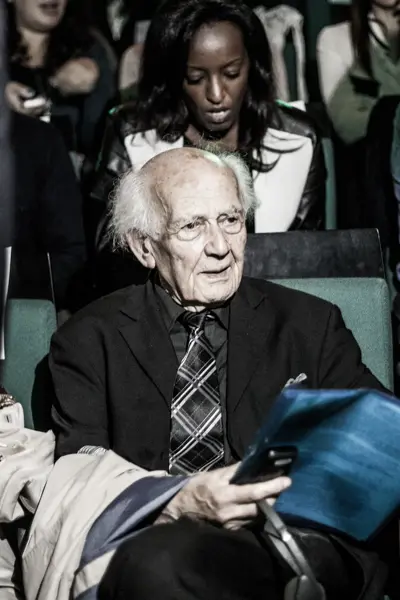
Zygmunt Bauman was a Polish sociologist and philosopher. He was driven out of the Polish People's Republic during the 1968 Polish political crisis and forced to give up his Polish citizenship. He emigrated to Israel; three years later he moved to the United Kingdom. He resided in England from 1971, where he studied at the London School of Economics and became Professor of Sociology at the University of Leeds, later Emeritus. Bauman was a social theorist, writing on issues as diverse as modernity and the Holocaust, postmodern consumerism and liquid modernity.
