Whittaker Chambers Quotes
On a scale personal enough to be felt by all, but big enough to be symbolic, the two irreconcilable faiths of our time - Communism and Freedom - came to grips in the persons of two conscious and resolute men.
Chambers, Whittaker. Witness. Random House, 1952, p. 4.


Wright, like so many idealists had been a communist before the reality about Stalin and Russia was public knowledge. He then became a virulent anti-Communist and appeared in many international gatherings of Black artists and intellectuals. However, he felt that the CIA funding of an organization called the American Society for African Culture was undermining his message and integrity.’

The president was surprised by the rapid spread and expansion of the anti-war movement at the time was convinced that the communists were organizing the effort. After all the investigations and histories, it was an extremely fast growing movement—perhaps the first of the digital political movements as e-mail was one of the tools used in the universities where e-mail was then coming into use.

He finally had to. In the government of national reconciliation, the Fascists—called Conservatives after WWII—were led by Don Manuel and he took the second place while the Republicans with the majority had the Prime Ministership. The Communists were part of the Republican coalition as they had been in the Civil War.


Kennan was one of the few people who saw the possibility of Soviet rule of Eastern Europe crumbling as it did almost 50 years later. Most Americans thought that the Soviet Union was so militarily entrenched that they would never be ousted short of war.


Baruch was the first politician to use of the phrase "cold war." It had actually been originated by a friend and speechwriter, Herbert Bayard Swope, who had proposed using the phrase earlier. Baruch thought that too early and waited.


Vladimir Lenin


The "iron curtain" phrase was used here a few months before Winston Churchill's famous speech using it {411311}. Also, it appears to have been used earlier than that by Nazi Propaganda Minister Joseph Goebbels in Das Reich. And Viscountess Snowden used the phrase in her memoirs of a Past WWI trip to Russia {616546}. It is not known whether Troubridge or Churchill were familiar with those works.


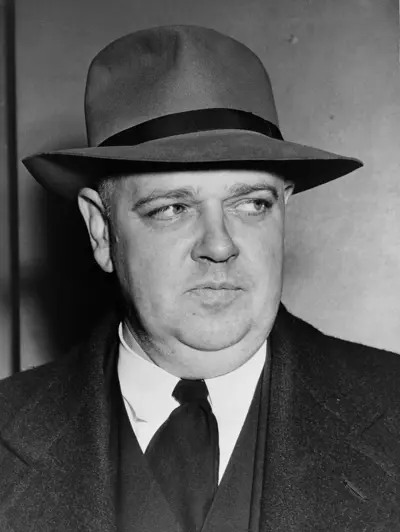
Whittaker Chambers was an American writer-editor, who, after early years as a Communist Party member (1925) and Soviet spy (1932–1938), defected from the Soviet underground (1938), worked for Time magazine (1939–1948), and then testified about the Ware group in what became the Hiss case for perjury (1949–1950), often referred to as the trial of the century, all described in his 1952 memoir Witness. Afterwards, he worked as a senior editor at National Review (1957–1959). US President Ronald Reagan awarded him the Presidential Medal of Freedom posthumously in 1984.
