Vannevar Bush Quotes
Of what lasting benefit has been man's use of science and of the new instruments which his research brought into existence? First, they have increased his control of his material environment. They have improved his food, his clothing, his shelter; they have increased his security and released him partly from the bondage of bare existence. They have given him increased knowledge of his own biological processes so that he has had a progressive freedom from disease and an increased span of life. They are illuminating the interactions of his physiological and psychological functions, giving the promise of an improved mental health. Science has provided the swiftest communication between individuals; it has provided a record of ideas and has enabled man to manipulate and to make extracts from that record so that knowledge evolves and endures throughout the life of a race rather than that of an individual.
Bush had advised FDR to go ahead with the research and development program to try and develop an atomic bomb. He was the only Government Official who Roosevelt discussed the idea with. At the time, Bush as a government official supervised and directed many thousands of scientists, and was one of just a few scientists who monitored and advised on the Manhattan Project to develop the Bomb.
Vannevar Bush, 1890-1974, Director of the U. S. Office of Scientific Research and Development, Vice President of MIT and Dean of the MIT School of Engineering, Founder of Raytheon, Presidential Science Advisor (Franklin Delano Roosevelt), “As We May Think”, July 1, 1945
Sourced by: Eigen's Political and Historical Quotations


Most environmentalists limit the vision of their solutions to using less of our precious natural resources which is very important but just as important and perhaps more so in the long run is increasing the supply of these resources. Food is an example. The major reason that there is no serious food shortage world-wide is that we have increased the productivity of agriculture requiring less labor, less water, less fertilizer, less land, and less dependency on weather. Distribution has also improved, but there is no very good way of distributing something for which there is a great shortage.


This is a remarkably accurate prediction of a process that has rapidly accelerated to a point that would surprise most people of the 18th century except de Condorcet.

Bush and some religious fundamentalists believe that even a fertilized human egg cell created for in vitro fertilization and not needed, is an incipient life. As such they oppose any use of these cells for anything but procreation of human life, and many oppose the concept of in vitro fertilization completely as it involves the killing and trivialization of life. Most Americans disagree and want to use the excess of fertilized eggs for research and help prolong and sustain life.


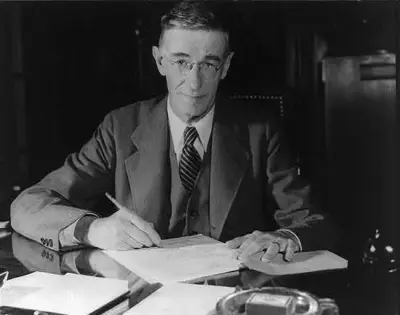
Vannevar Bush was an American engineer, inventor and science administrator, who during World War II headed the U.S. Office of Scientific Research and Development (OSRD), through which almost all wartime military R&D was carried out, including important developments in radar and the initiation and early administration of the Manhattan Project. He emphasized the importance of scientific research to national security and economic well-being, and was chiefly responsible for the movement that led to the creation of the National Science Foundation.
