John Polkinghorne Quotes
Of course, Einstein was a very great scientist indeed, and I have enormous respect for him, and great admiration for the discoveries he made. But he was very committed to a view of the objectivity of the physical world.
Polkinghorne, John. Interview by Margaret Wertheim. Faith and Reason, PBS, 1998.


This quotation illustrates a way in which science is frequently at odds with politics. Our politicians realize the importance of scientific research to our standard of living, economy, and quality of life. So they want to support research and development programs. However, budgeting and planning for these in terms of expected or desired results is virtually impossible. So scientific research, especially basic research is not susceptible to the usual planning and monitoring that is so common and effective in construction projects or other applications of science and technology. It is hard to predict when and which scientists will have the next critical idea. It is very difficult to hold scientists or administrators accountable for scientific research results because of this factor. See {624876}.

We have two opposite dynamics operating today. On the one hand the scientific breakthroughs like Quantum Mechanics and genetic engineering widen the intellectual gap immensely between the average person (and politicians) and the scientist—at a time when society must make enormous decisions on scientific matters. On the other hand, there have never been so many people before educated in the sciences. There are many (not a majority) high school students who today understand Relativity and even well and broadly educated non-science college graduates are often familiar with Relativity, Quantum Mechanics, and other scientific breakthroughs of the 20th century. The world as a whole has never had so many scientifically literate people as today, nor has it ever had so many scientifically illiterate people today.


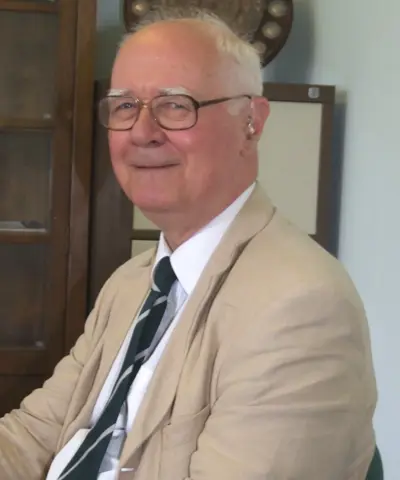
John Charlton Polkinghorne KBE FRS was an English theoretical physicist, theologian, and Anglican priest. A prominent and leading voice explaining the relationship between science and religion, he was Professor of Mathematical Physics at the University of Cambridge from 1968 to 1979, when he resigned his chair to study for the priesthood, becoming an ordained Anglican priest in 1982. He served as the president of Queens' College, Cambridge, from 1988 until 1996.
