Lucretius Quotes
O goddess, bestow on my words an immortal charm.
Lucretius. On the Nature of Things. Translated by W. H. D. Rouse, Harvard University Press, 1924, p. 5.


Unfortunately, much modern Islamic philosophy and religion sees new knowledge and innovation of ideas as heresy. However, this was not at all true at the beginning of Islam. This narrow-mindedness and intolerance began to develop in 1100, hundreds of hears after Mohammad. Contrast Abu Hanifa with an Islamic modern fundamentalist who claims there can be no valid new knowledge: {620307}.


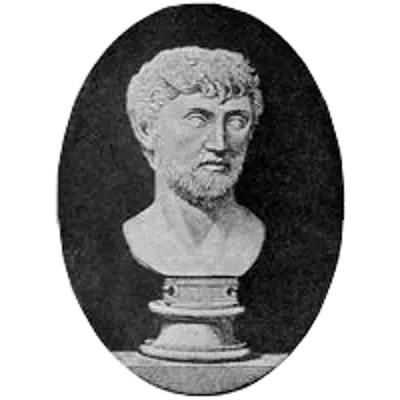
Titus Lucretius Carus (/ˈtaɪtəs luːˈkriːʃəs/ TY-təs loo-KREE-shəs, Latin: [ˈtɪtʊs lʊˈkreːtɪ.ʊs ˈkaːrʊs]; c. 99 – c. 55 BC) was a Roman poet and philosopher. His only known work is the philosophical poem De rerum natura, a didactic work about the tenets and philosophy of Epicureanism, and which usually is translated into English as On the Nature of Things. Lucretius has been credited with originating the concept of the three-age system that was formalised in 1836 by C. J. Thomsen.
