Desiderius Erasmus Quotes
Nothing is as peevish and pedantic as men's judgments of one another.
Erasmus, Desiderius. Praise of Folly. Translated by Betty Radice, Penguin Books, 1971.


The headline was changed after the first 100,000 copies had been distributed.


The Congress was debating President Johnson’s Voting Rights Bill. Southern Democrats and Conservative Republicans were opposed to legislation that would prevent states from discriminating against Black and other minority voters. Johnson needed the support of minority leader Dirksen and the moderate Republicans. Dirksen was at the White House discussing the strategy for the passage of the bill. This quotation illustrates the “partisanship of the day” where opponents were quite friendly even when they were “denouncing” each other, The venom and personal disrespect and hatred of the beginning of the 21st century was absent in the 1960s even though the most radical and controversial legislation was being debated. The Civil Rights Act, the Voting Rights Act, Non Discrimination in Housing and Medicare were all passed that year with filibusters and cloture votes. Yet there was always comity.


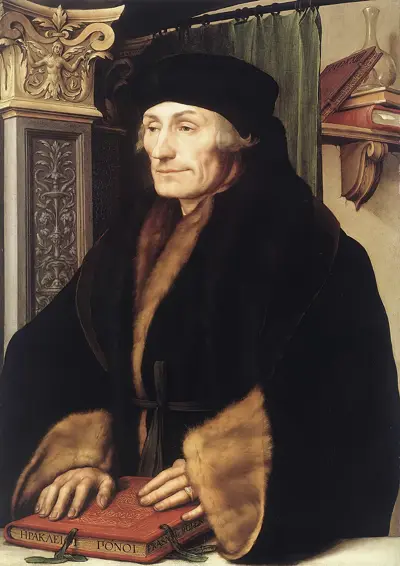
Desiderius Erasmus Roterodamus was a Dutch philosopher and Christian scholar who is widely considered to have been one of the greatest scholars of the northern Renaissance. As a Catholic priest, Erasmus was an important figure in classical scholarship who wrote in a pure Latin style. Among humanists he enjoyed the sobriquet "Prince of the Humanists", and has been called "the crowning glory of the Christian humanists". Using humanist techniques for working on texts, he prepared important new Latin and Greek editions of the New Testament, which raised questions that would be influential in the Protestant Reformation and Catholic Counter-Reformation. He also wrote On Free Will, In Praise of Folly, Handbook of a Christian Knight, On Civility in Children, Copia: Foundations of the Abundant Style, Julius Exclusus, and many other works.
