Homer Quotes
Nothing feebler than a man does the earth raise up, of all the things which breathe and move on the earth, for he believes that he will never suffer evil in the future, as long as the gods give him success and he flourishes in his strength; but when the blessed gods bring sorrows too to pass, even these he bears, against his will, with steadfast spirit, for the thoughts of earthly men are like the day which the father of gods and men brings upon them.
Homer. The Odyssey. Translated by A.T. Murray, Harvard University Press, 1919, Book 18, lines 130-137.


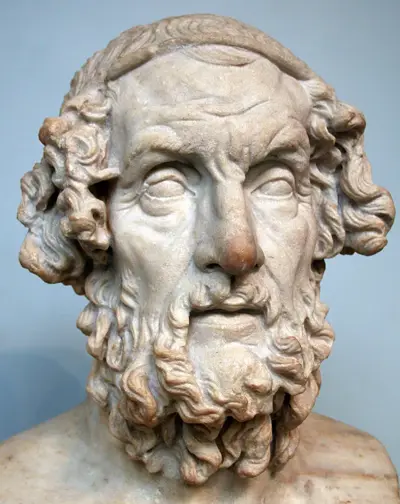
Homer (/ˈhoʊmər/; Ancient Greek: Ὅμηρος [hómɛːros], Hómēros) was the presumed author of the Iliad and the Odyssey, two epic poems that are the foundational works of ancient Greek literature. The Iliad is set during the Trojan War, the ten-year siege of the city of Troy by a coalition of Greek kingdoms. It focuses on a quarrel between King Agamemnon and the warrior Achilles lasting a few weeks during the last year of the war. The Odyssey focuses on the ten-year journey home of Odysseus, king of Ithaca, after the fall of Troy. Many accounts of Homer's life circulated in classical antiquity, the most widespread being that he was a blind bard from Ionia, a region of central coastal Anatolia in present-day Turkey. Modern scholars consider these accounts legendary.
