Oliver Wendell Holmes Jr. Quotes
Nobody talks much that doesn't say unwise things,--things he did not mean to say; as no person plays much without striking a false note sometimes.
Oliver Wendell Holmes, 1809-1894, Author and Physician, Father of the Supreme Court Justice, The Professor at the Breakfast Table
Sourced by: Eigen's Political and Historical Quotations

He had been asked about one of his recent major statements which insulted large numbers of Americans. See {631015} for some of the text that caused him so much trouble and triggered this very inelegant explanation.


During the U.S. Civil war the Prime Minister suggested publicly that Britain favored the South. This caused a political stir on both sides of the Atlantic:


The majority leader was known for shooting from the hip. He had recently made one incorrect and embarrassing statements. His aide asked him why.


Reagan, Ford, Bush, Clinton


The Senator almost certainly meant to say “disagree” but “agree” is what came out in a gaff that had his Western Pennsylvania audience very confused.

While this probably was a slip of the tongue, President Bush and governor Perry both had civil right and individual had rights as a lower priority than a individual responsibility, strong growth economy or the military. There were many who really believed that the two men really thought excessive personal reedom a problem that people and the government must be protected from, like freedom for a woman to choose an abortion. For Perry in particular many thought that if this was a slip of the tounge, it was likely a Freudian slip as it what he really wants.

He meant to say “repository” and not “suppository”. The latter is a capsule of medicine that is placed inside the rectum.

Albert Einstein {199615} and others did not believe that the combination was possible except for short periods of time.


In his boisterous dissent he read from the bench in the EPA v. EME Homer City case, Supreme Court Justice Antonin Scalia, made a mistake and in citing a previous opinion he had written, he made an error recalling what he had written previously. Critics of the justice not only castigated him but made fun of his seemingly foolish error that a law student should not make. Whalen’s quotation is important because it illustrated the highly partisan tone in American politics at that. Whalen, a partisan conservative explains how he would do the same thing if a liberal judge made a mistake. The error was corrected in the final published version of the opinion, and it did not affect the logic of the dissent or even the factual arguments for the dissent. Yet the quest for partisan advantage and trashing a political opponent was so in vogue that a minor mistake was treated as a major political scandal. The end of the 20th century and the beginning of the 21st were not the most partisan and nasty era of American politics but it was one of the worst.

Wikipedia: This was Debs's most famous speech. It was a socialist antiwar speech while the United States was at war, and it was used against him at his trial. Debs was convicted under the Espionage Law and sentenced to 10 years in prison. President Warren G. Harding commuted the sentence in 1921. The Espionage Act was so written that speaking against the war was defined as “Espionage”. This act and the Alien & Sedition Acts were the greatest infringements on Freedom of Speech in the History of the country and on both occasions, the Supreme Court chose not to get involved.

Samuel Langhorne Clemens, 1835-1910

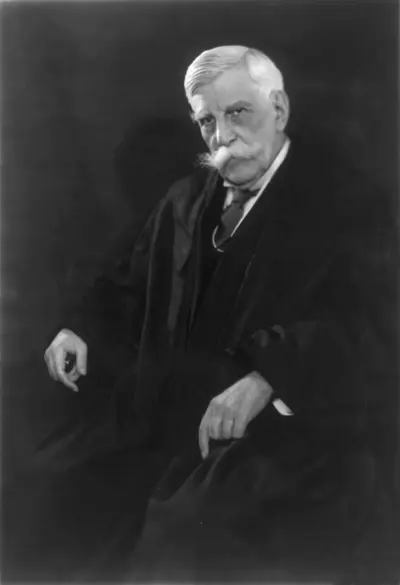
Oliver Wendell Holmes Jr. was an American jurist who served as an Associate Justice of the Supreme Court of the United States from 1902 to 1932. Noted for his long service, concise and pithy opinions, and deference to the decisions of elected legislatures, he is one of the most widely cited United States Supreme Court justices in history, particularly for opinions on civil liberties and American constitutional democracy, and is one of the most influential American common law judges, honored during his lifetime in Great Britain as well as the United States. Holmes retired from the court at the age of 90, an unbeaten record for oldest justice in the federal Supreme Court (although John Paul Stevens was only 8 months younger when he retired on April 12, 2010). He previously served as an Associate Justice and as Chief Justice of the Massachusetts Supreme Judicial Court, and was Weld Professor of Law at his alma mater, Harvard Law School.
