Ernest Hemingway Quotes
No weapon has ever settled a moral problem. It can impose a solution but it cannot guarantee it to be a just one. You can wipe out your opponents. But if you do it unjustly you become eligible for being wiped out yourself.


This was the group that decided who was to be executed in the Reign of Terror

The Lebanese Prime Minister had been assassinated with most Lebanese thinking that the Syrians were behind the murder. All the political parties in Lebanon called for a UN Tribunal to investigate the assassination. As the Tribunal was ending its investigation, word leaked out that the report would name Lebanese Hezbollah operatives as being involved in the assassination. If that happened, the Lebanese government and army would have the obligation to arrest the murders for trial and Lebanon would be split against Hezbollah which was the most powerful and militant political group as well as being a terrorist group. Hezbollah declared that they would not allow any arrests of their people, and that they wanted the Government, led by the murdered politicians son to repudiate the UN Tribunal even before the report was issued. When that failed, Hezbollah withdrew from the government coalition and reconstituted a government without the son of the murdered Prime Minister who was then thrown out of office. Jumblatt’s Druze party held the balance of power and surprisingly sided with Hezbollah. Usually he was a strong advocate for justice. However, if he refused to go along with Hezbollah, they would use their terror troops against the Lebanese army and civil war would result. Hence Jumblat’s answer—a classic statement of a political dilemma.


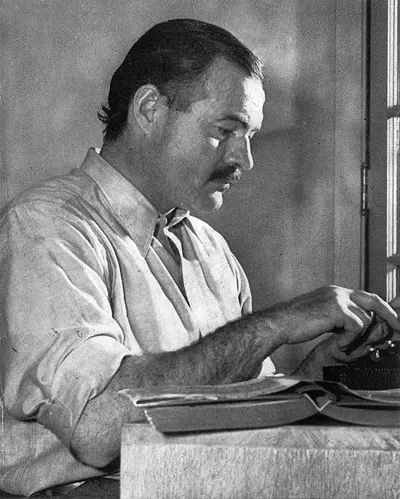
Ernest Miller Hemingway was an American novelist, short-story writer, journalist, and sportsman. His economical and understated style—which he termed the iceberg theory—had a strong influence on 20th-century fiction, while his adventurous lifestyle and his public image brought him admiration from later generations. Hemingway produced most of his work between the mid-1920s and the mid-1950s, and he was awarded the Nobel Prize in Literature in 1954. He published seven novels, six short-story collections, and two nonfiction works. Three of his novels, four short-story collections, and three nonfiction works were published posthumously. Many of his works are considered classics of American literature.
