Carl Sagan Quotes
[N]o scientist likes to be criticized. ... But you don't reply to critics: "Wait a minute, wait a minute; this is a really good idea. I'm very fond of it. It's done you no harm. Please don't attack it." That's not the way it goes. The hard but just rule is that if the ideas don't work, you must throw them away. Don't waste any neurons on what doesn't work. Devote those neurons to new ideas that better explain the data. Valid criticism is doing you a favor.
Sagan, Carl. The Demon-Haunted World: Science as a Candle in the Dark. Random House, 1996, p. 240.


Most politicians would never do this. Ideologues rarely analyze their beliefs. Pragmatic politicians are fearful of being called a flip flopper with no core principles. However, some politicians follow this advice. For example, Abraham Lincoln and Franklin Delano Roosevelt were both among the rare politicians who would frequently change positions as they learned more. See John Maynard Keynes {619441} for a personal statement of this principle and {636175} for a modern view.

When a scientist is persuaded to change his position, he is acting in the great tradition of the best of scientists. When a politician does the same, he is a flip flopper, without any real principles and clearly not to be trusted. A scientist would not be trusted by his peers if he did not readily change is views.


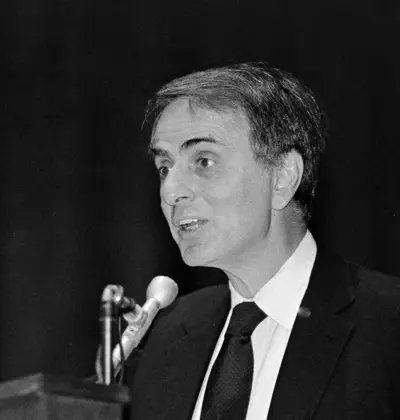
Carl Edward Sagan was an American astronomer, planetary scientist, cosmologist, astrophysicist, astrobiologist, author, and science communicator. His best known scientific contribution is research on extraterrestrial life, including experimental demonstration of the production of amino acids from basic chemicals by radiation. Sagan assembled the first physical messages sent into space: the Pioneer plaque and the Voyager Golden Record, universal messages intended to be understood by any extraterrestrial intelligence that might find them.
