Livy Quotes
No law is sufficiently convenient to all.
Livy. Livy: History of Rome, Books 31-34. Translated by Evan T. Sage, Harvard University Press, 1935, p. 423.


The Lebanese Prime Minister had been assassinated with most Lebanese thinking that the Syrians were behind the murder. All the political parties in Lebanon called for a UN Tribunal to investigate the assassination. As the Tribunal was ending its investigation, word leaked out that the report would name Lebanese Hezbollah operatives as being involved in the assassination. If that happened, the Lebanese government and army would have the obligation to arrest the murders for trial and Lebanon would be split against Hezbollah which was the most powerful and militant political group as well as being a terrorist group. Hezbollah declared that they would not allow any arrests of their people, and that they wanted the Government, led by the murdered politicians son to repudiate the UN Tribunal even before the report was issued. When that failed, Hezbollah withdrew from the government coalition and reconstituted a government without the son of the murdered Prime Minister who was then thrown out of office. Jumblatt’s Druze party held the balance of power and surprisingly sided with Hezbollah. Usually he was a strong advocate for justice. However, if he refused to go along with Hezbollah, they would use their terror troops against the Lebanese army and civil war would result. Hence Jumblat’s answer—a classic statement of a political dilemma.

The Senator was arguing against a bill to correct an aspect of the immigration law where infants and very young clildren are broght to the United States by parents who entered illegally. The children grow up in the United States—the only country and home that they have ever known. American law required that they be deported to “their countries” which they have no memory of and many do not even speak the language or know the culture. Sessions, is an example of the view that law defines justice. Therefore laws cannot be unjust nor can enforcing the law. Opponents point out that even in the United States we have, in earlier times, “enforced the law” which we came to regret and see as an injustice. The Fugitive slave laws, the Southern racial discrimination laws, and the law allowing Japanese American Citizens to be interned and lose their land during WWII are a few examples of laws, the enforcement of which is seen by most Americans as having been unjust. The execution of “witches” in early America was in conformity with the law.


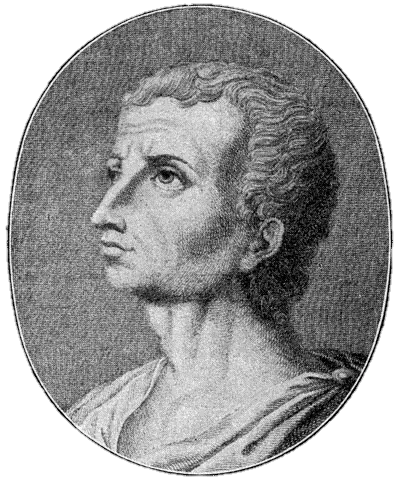
Titus Livius (/ˈlɪviəs/ LIV-ee-əs, Latin: [ˈtɪtʊs ˈliːwijʊs]; 64/59 BC – AD 12/17), known as Livy (/ˈlɪvi/ LIV-ee) in English, was a Roman historian. He wrote a monumental history of Rome and the Roman people, titled Ab Urbe Condita, ''From the Founding of the City'', covering the period from the earliest legends of Rome before the traditional foundation in 753 BC through the reign of Augustus in Livy's own lifetime. He was on familiar terms with members of the Julio-Claudian dynasty and even in friendship with Augustus, whose young grandnephew, the future emperor Claudius, he exhorted to take up the writing of history.
