Thomas A. Edison Quotes
Nature made us - nature did it all - not the gods of the religions.
Marshall, Edward. "'No Immortality of the Soul' Says Thomas A. Edison." The New York Times, 2 Oct. 1910, p. SM1.

Darwin who had a Protestant Christian upbringing, never precluded the possibility that God had created the universe with the Laws of Evolution and that was the mechanism He selected to allow all the species and diversity of life to develop. But he did not say that explicitly. While he found immediate acceptance and accolades from the scientific communities throughout the world, and enthusiastic approval by most educated people with the exception of theologians and clerics. Their reaction was extreme—almost apoplectic. The book as a best seller and they sold out with each successive printing. In the 6th edition, Darwin not only was explicit about the role the Deity might have had, but Darwin stated that he personally believed that He was the impetus to the creative process. Ironically, almost all the social and political opponents of Evolution have never read Darwin’s work (or much else on the subject) and certainly do not realize that the man they accuse of leaving God out of the Creation, actually believed that God was the critical element and he and other evolutionary scientists were just discovering God’s laws. Dr. Huxley and some other supporters of Darwin were disappointed with this change in the 6th edition, as they were atheists and believed that there was no deity involved in the creation. Today, there are evolutionary scientists who are on both sides of the issue. They just disagree on this point, but they work together on everything else.


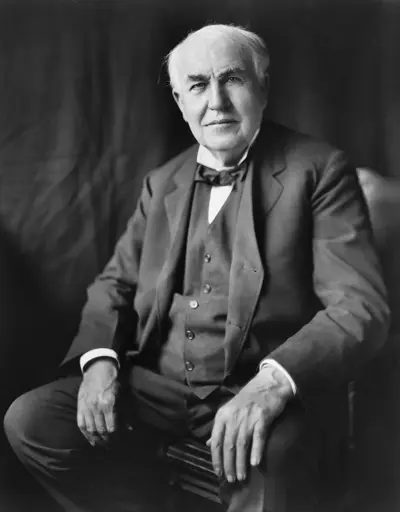
Thomas Alva Edison was an American inventor and businessman who has been described as America's greatest inventor. He developed many devices in fields such as electric power generation, mass communication, sound recording, and motion pictures. These inventions, which include the phonograph, the motion picture camera, and early versions of the electric light bulb, have had a widespread impact on the modern industrialized world. He was one of the first inventors to apply the principles of organized science and teamwork to the process of invention, working with many researchers and employees. He established the first industrial research laboratory.
