Martin Van Buren Quotes
Mutual forbearance and reciprocal concessions: thro' their agency the Union was established - the patriotic spirit from which they emanated will forever sustain it.
Van Buren, Martin. "Letter to the Democratic Citizens of Philadelphia." 4 July 1838. Niles' National Register, vol. 54, William Ogden Niles, 1838, p. 324.


The quotation was made in the context of the Arab Israeli conflict, but the principle is general.


The Barbary Pirates had an incredible extortion racket going in the Mediterranean. If nations would pay them an annual sum each year, they would not attack and seize merchant ships of that country and sell the ships and goods while holding the sailors for ransom. See {640845} ,{640846} & {640848}


In 1871 the congressman refused to serve as chairman of a committee to investigate the Ku Klux Klan. Such pandering to the South was common for politicians who had national aspirtation. If the politican served on such a committee, he would have to aknowledge the existance of the murders, torture, and other criminal activity of an organzation that was very popular in the South. Or he would have to cover up the KKK crimes and lose the support of Northerners. So refusing to serve on the committee was the prudent solution.


Henry of Navarre. The Great Council was the first proposed International governing body—a precursor to the EEC, the UN and the League of Nations. Henry's plan included an international army and navy to enforce the decisions. There were 15 nations proposed in the Great Design. Each one had a veto presaging the United Nations Security Council.


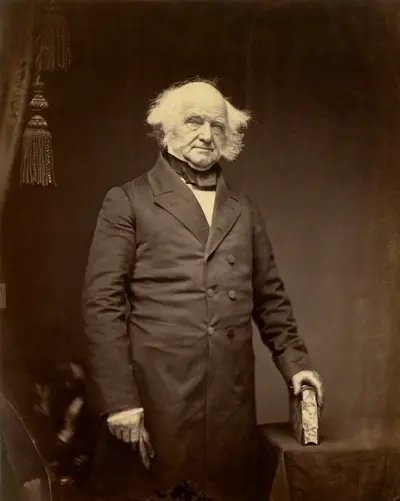
Martin Van Buren was an American lawyer and statesman who served as the eighth president of the United States from 1837 to 1841. A founder of the Democratic Party, he had previously served as the ninth governor of New York, the tenth United States secretary of state, and the seventh vice president of the United States. He won the 1836 presidential election with the endorsement of popular outgoing President Andrew Jackson and the organizational strength of the Democratic Party. He lost his 1840 reelection bid to the Whig nominee, William Henry Harrison, thanks in part to the poor economic conditions surrounding the Panic of 1837. Later in his life, Van Buren emerged as an elder statesman and an important anti-slavery leader who led the Free Soil Party ticket in the 1848 presidential election.
