A. P. J. Abdul Kalam Quotes
Medical costs are of concern, both in developing and developed countries.
Kalam, A. P. J. Abdul, and Y. S. Rajan. India 2020: A Vision for the New Millennium. Penguin Books India, 1998.


Unlike most forms of insurance virtually everyone will have one or more claims and collect in his or her lifetime. Many of use will never have an automobile crash and collect on our insurance policy, but health is different in that we all change health status from well to ill at times and if we are fortunate we return to a state of wellness. But as Eigen observes, most of us who are tell are only temporarily well, With time our state will change to ill and if we are not very fortunate we will never use our health insurance as we will be dead. There is almost no way to age in a modern society without needing health care or funeral services, That is the consequence of the normal process of aging. So with health insurance schemes we, in effect, pass money from the living well to the living ill. So if health care costs increase fastr than inflation, which it has almost always done in the last half century, the temporarily well will be paying more and more. The only way to break that cycle is to somehow limit the cost increases of health care to that of the inflationary increase. Eigen has argued that most of us focus on the wrong problem--the details of the way the well pay for the ill, when the only soltuion is to reduce the rate of increases of health care costs. And there are only 2 ways to do that: Reduce the compensation for all the health care actors--physicians, nurses, other staff, hospitals, and manufacturers of medical equipment, supplies and expecially pharmaceuticals which have been increasing at the fastest rate of all or wer privide more and more effective prevention.


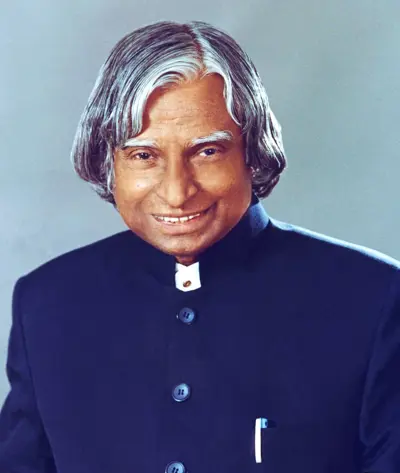
Avul Pakir Jainulabdeen Abdul Kalam was an Indian aerospace scientist and politician who served as the 11th President of India from 2002 to 2007. He was born and raised in Rameswaram, Tamil Nadu and studied physics and aerospace engineering. He spent the next four decades as a scientist and science administrator, mainly at the Defence Research and Development Organisation (DRDO) and Indian Space Research Organisation (ISRO) and was intimately involved in India's civilian space programme and military missile development efforts. He thus came to be known as the Missile Man of India for his work on the development of ballistic missile and launch vehicle technology. He also played a pivotal organisational, technical, and political role in India's Pokhran-II nuclear tests in 1998, the first since the original nuclear test by India in 1974.
