Margaret Chan Quotes
Maternal mortality health is a very sensitive indicator. All you need to look at is a country's maternal mortality rate. That is a surrogate for whether the country's health system is functioning. If it works for women, I'm sure it will work for men.
Chan, Margaret. "Address at the Women Deliver Conference." World Health Organization, 18 Oct. 2007.


In some areas, the United States has the best performance in the entire world—length of survival rates for breast cancer and some other diseases for example. However, on basic medical services, like infant mortality, we have a poorer record than all the other industrialized countries. Cuba and Costa Rica are better than us in this area and their citizens actually have a longer life expectancy than Americans. Emmanuel makes the argument that the cost differential between US health care and other—even better systems—is so great that we can easily save money and reform our system without rationing medical care or wait in lines for surgery. However, to do so, there must be huge reforms and few in the system want to risk changing anything. It is hard for most Americans to face the fact that other countries offer obvious medical superiority in many areas. For example, in France, if you call their emergency telephone number for a medical emergency a doctor answers the phone, not an operator with only modest medical knowledge. When a French ambulance is dispatched, it does not have emergency medical technicians only, but there is a doctor and a nurse in the ambulance. And the ambulance itself is equipped to do emergency surgery of other critical treatment if time is critical.


The United States in a few medical areas (such as treating breast cancer) is the best in the world but on almost all general medical criteria we are not at, and sometimes not near, the top. Dramatic examples are infant mortality and even life expectancy where we are not even as good as Costa Rica. A large proportion of the infant mortality lies within the women who do not have health insurance and hence have little or no pre-natal care. The smaller life expectancy is partially a function of the high infant mortality rate, but is also brought down by the large American prevalence of smoking, heart disease, cancer, traffic deaths, alcohol-related deaths and gun deaths,

26 years after the Castro led Cuban Revolution Although the Cuban economy tanked under Castro’s communism, the progress in health, nutrition and education were amazing—the greatest progress in the least time that occurred in history except for the possible exception of Israel. Castro, however, accomplished these achievements trampling over people’s individual rights. If a Cuban was literate, it mattered not whether he/she wanted to teach others. This was a requirement with no pay provided.

Alinsky was one of the first of the modern politicians who realized the growing control over peoples’ lives that the health care was assuming. Getting decent health care at an affordable price was getting more and more difficult for the working class unless provided by an employer, and the poor were already at the mercy of whatever system there was in the area as they could go nowhere else.


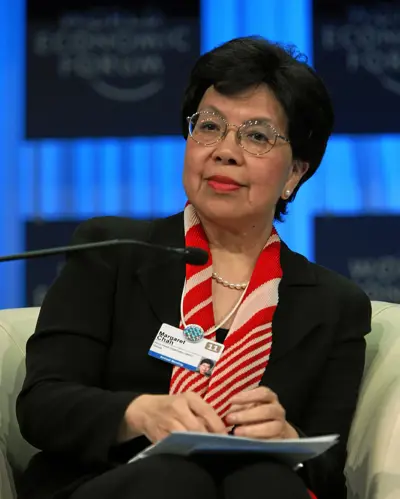
Margaret Chan Fung Fu-chun, OBE, JP, FRCP is a Chinese-Canadian physician, who served as the Director-General of the World Health Organization (WHO) delegating the People's Republic of China for 2006–2017. Chan has previously served as Director of Health in the Hong Kong Government (1994–2003), representative of the WHO Director-General for Pandemic Influenza and WHO Assistant Director-General for Communicable Diseases (2003–2006). In 2014, Forbes ranked her as the 30th most powerful woman in the world. In early 2018 she joined the Chinese People's Political Consultative Conference (CPPCC).
