Henry David Thoreau Quotes
Let us not underrate the value of a fact; it will one day flower in a truth. It is astonishing how few facts of importance are added in a century to the natural history of any animal. The natural history of man himself is still being gradually written.
Thoreau, Henry David. "Natural History of Massachusetts." The Dial, vol. 3, no. 1, Jul. 1842, p. 23.


Science has the interesting characteristic that most failures are successes in the sense that scientific knowledge is gained from the failure even if it only a guide to what not to do in the future. Politics would be well served to adopt this pragmatic approach, but ideology usually prevails in politics and errors tend to be repeated if there are supported by political philosophy or ideology.


In 1877 Wasburn was dropped from the List of Ministers by the Unitarian Church. He had become very critical of organized and orthodox religion of all kinds.


For historians, this is a difficult concept to comprehend, but with the passage of time, Feynman may well be right.

This characteristic of science causes the politicians great difficulty when allocating public funds for scientific research. It is often very hard to attribute credit to the right scientist when a scientist herself might not yet realize the great significance of her work. Of a number of different scientists each contributing one step of a process when the person who worked on the last link could not possibly have done it without the others along the way. Who to fund and why is terribly frustrating which is why the National Science Foundation and the National Institutes of Health make most of their funding decisions on the basis of proposals and peer review and decision making. None the less, many politicians are constantly trying to interject their preferences, almost always based on their ignorance, especially when they can get research funds into their district.


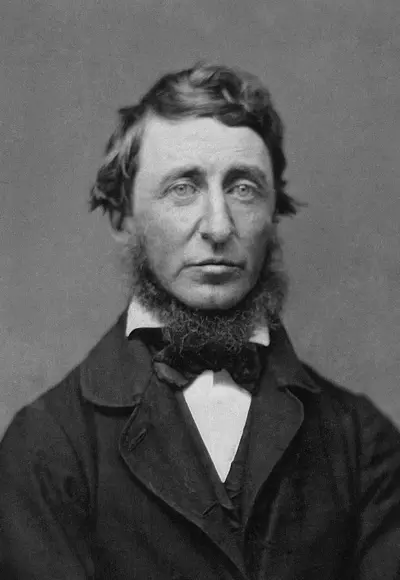
Henry David Thoreau was an American naturalist, essayist, poet, and philosopher. A leading transcendentalist, he is best known for his book Walden, a reflection upon simple living in natural surroundings, and his essay "Civil Disobedience" (originally published as "Resistance to Civil Government"), an argument for disobedience to an unjust state.
