A. P. Herbert Quotes
Justice should be cheap but judges expensive.
Alan Patrick Herbert, 1890-1971, British Writer & Member of Parliament, "What Is a Judge?", Uncommon Law, 1935
Sourced by: Eigen's Political and Historical Quotations

In most of the world this is an accepted truism. However, where there is judicial independence as in the United States, Israel, Norway, England and other countries, those who appoint judges have little or no control over a judiciary that has lifetime tenure and a tradition of non-interference. The influence is limited to the appointment of a judge with a particular philosophy. However, in some countries, not only do the courts follow the lead of the government but if they do not the judges themselves might be jailed or worse. Borelli’s principle therefore holds there.


Sealed under duress and later repudiated by the King with Papal assistance


He was discussing the military criminal cases ongoing regarding the mistreatment of Iraqi detainees.

She was a judge before she had been a member of Congress.


A case of systemic racial discrimination against a Bank of America subsidiary which she had initiated in 2008 had been resolved by the Bank paying over $200 million to the victims.

This political issue has been in contention in every major world power since the Roman Empire. There has always been a division between hard liners and others. At issue is whether the nation should defend and or take up the cause of any national, individual, corporation, ideals even against a foreign country who may object to the behavior or use their own legal system to punish violators of their local laws. Failure to do so, they have argued over the years, makes the power appear weak and will invite further insult and transgressions. They claim that the government’s duty is always to protect its citizens from foreign elements regardless of whether the citizen’s behavior is right or wrong, reasonable or unreasonable, honest or dishonest. Also, this view holds that the nation should NEVER apologize as this makes it seem weak. These people have argued that it is the obverse of “My Country, Right or Wrong” and should be “Our Citizens, Right or Wrong”. On the other side, it is claimed that defending citizens or institutions that are clearly in the wrong not only is morally and ethically improper, but by being so indiscriminate, it weakens the nation’s power and credibility when it later wants to defend its citizens who are in the right and are being railroaded and discriminated against. And an apology, if the individual and institution has been in the wrong or caused harm and damage, is the proper thing to do and will often resolve matters and this is the best outcome often for the erring individual or institution. It is such a universal political issue of contention, that in the 2012 Presidential Campaign Mitt Romney had castigated President Barack Obama for apologizing to the African Nations for forcing their ancestors into American Slavery, even though Romney was very much opposed to slavery. It was the apology that makes America seem weak. The other side is that the apology shows that America has strong democratic principles and occasionally falls short, and when it does so, it acknowledges and corrects it setting a democratic example for all.


For a later variation of this idea see Stanislaw Lec {608869}. Ingersoll was considered to be the greatest orator and political thinker of his day, but his overt atheistic views curtailed his elected political career.


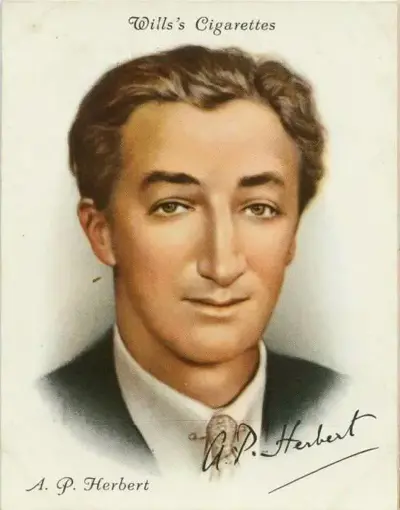
Sir Alan Patrick Herbert CH, usually known as A. P. Herbert or simply A. P. H., was an English humorist, novelist, playwright and law reform activist, and an Independent Member of Parliament for Oxford University from 1935 until 1950, when university constituencies were abolished. Born in Ashtead, Surrey, Herbert attended Winchester College and New College, Oxford, graduating with a starred first in Jurisprudence in 1914. He joined the Royal Naval Volunteer Reserve as an ordinary seaman in World War I, later serving as an officer with the Royal Naval Division. He fought in Gallipoli and on the Western Front, becoming battalion adjutant in 1917, before injury excluded him from the front line. After the war, he published The Secret Battle and joined the staff of Punch in 1924. He also wrote librettos for musicals. Elected as Independent MP for Oxford University in the 1935 general election, Herbert campaigned for private member's rights, piloted the Matrimonial Causes Act 1937 through Parliament, opposed the Entertainments Duty, and campaigned against the Oxford Group. He joined the River Emergency Service in 1938 and served in World War II as a petty officer in the Royal Naval Auxiliary Patrol. He captained his river boat, the Water Gipsy, on the River Thames. In 1943, he joined a parliamentary commission to investigate the future of the Dominion of Newfoundland.
