Wilhelm II, German Emperor Quotes
Just as the Huns under their king Attila created for themselves a thousand years ago a name which men still respect, you should give the name of German such cause to be remembered in China that no Chinaman will dare look a German in the face.
Gauss, Christian. The German Emperor As Shown in His Public Utterances. Charles Scribner's Sons, 1915, p. 172.


This article reached America where the insult proved a patriotic rallying point.


1st Earl of Beaconsfield

During her adult life, she was the de facto ruler of China. This quotation is very important because it gives us an important insight into Chinese motives and historical drivers. The first reason is something almost all countries and cultures can identify with, but the second--to avoid being looked down—was just as important. Americans are relatively uncaring what the citizens of other countries think about them, but the Chinese do. So do other nationalities and cultures like the Arabs, the Iranians, many of the South American cultures. Often it takes on a different world like “dignity” or “respect”.

Hoxha was a mixture of extreme Communist and extreme nationalist. Note the paranoia about intermarriage and interbreeding with other nationalities which was typical of Balkan nations,. He actually deluded himself into thinking that Albanian occupation and invasion had never resulted in female fraternization or rape and subsequent ethnic mixing. International communism however, on this point was just the opposite of Hoxha’s—the advocated an international view of intermarriage and breeding. Theirs was a class paranoia, not a nationalistic or racial paranoia.


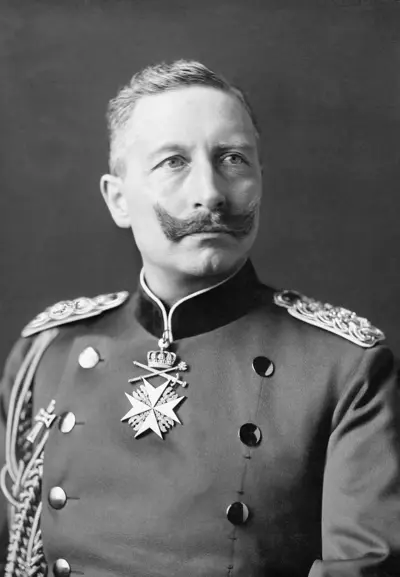
Wilhelm II, anglicised as William II, was the last German Emperor (Kaiser) and King of Prussia, reigning from 15 June 1888 until his abdication on 9 November 1918. Despite strengthening Germany's position as a great power by building a blue-water navy and promoting scientific innovation, his tactless public statements greatly antagonized the international community and his foreign policy was seen by many as one of the causes for the outbreak of World War I. When the German war effort collapsed after a series of crushing defeats on the Western Front in 1918, he was forced to abdicate, thereby bringing an end to the three-hundred-year rule of the House of Hohenzollern.
