Leon Trotsky Quotes
[Joseph] Stalin closes the exposition of these [Leon Trotsky] ideas with the words, "Such are in general the characteristic features of [Vladimir] Lenin's conception of the proletarian revolution."
Trotsky, Leon. The Third International After Lenin. Pioneer Publishers, 1936.


Lenin, Uritsky, and other Bolshevik leaders were attacked in 1918. Lenin was wounded but Utrtsky died, and this triggered the attacks on the other Russian factions by the Bolsheviks known as the “Red Terror.”


This is a very important historical, political quotation. The conservatives have since the Russian Revolution conflated socialism and communism. However, here in 1932 the leader of the American Socialist Party had already described the Communist Revolution in Russia as a failure of founding an acceptable modern state. Nonetheless, even into the 21st century many conservatives describe Thomas as a Communist. See {626692} for his distinction between Communism and Socialism. The difficulty of modern nation building was explained by Thomas and others but was really not accepted until the many attempts of the early 21st century, some supported by America like Iraq and Afghanistan and the Balkans and others like the “Arab Spring.” Then his early wisdom on this point became more appreciated.


This was one of the first of the world communist leaders who had concluded that the Russian communist state and its revolution had failed. Russia of 1923 was perceived as too dictatorial and not democratic enough. At the same time they thought Russia had not only sold out the democratic nature of communism but also the economic as well by having too much private property and making economic deals with Western capitalists giving concessions of all kinds to Krupp and other major Multinational companies to try and develop international trade and investment. Politically the communist critics thought Russian communism too left wing and undemocratic and economically too right wing and capitalistic.

The headline was an eyecatcher. The small type went on to say that all kinds of germs and other things can grow in a washroom if everything is not kept dry. At the time there was a national fear of anarchists and we were in the midst of a red scare.

He served as a liaison with the Russian military officers after WWII. As a result he developed friendships with some who told him much about Stalin and the Communist party of the Soviet Union.

According to Palmer, all labor strikes were a part of the international communist movement to take over America. This quotation is an excellent example of the conflation and the strange logic of the extreme anti-communists of the red scare. It started with a railroad strike. Because some of the strike leaders were socialists and some communists, the strike was communist. And if it was communist, the strike is but one step in capturing the political and economic power of the nation, and the purpose of that was to overthrow the government and substitute the governmental structure of Russia. With such thinking no labor action could be seen as American and patriotic if there were any socialists or communists participating in the strike. Later in the McCarthy era, a strike would be a menace if any participant even had been a communist or was related to one or had friends who were communists or even if not but the Communists morally supported the strikers, then the strike was dangerous. The same thing for civil rights. The Communists loudly opposed racial segregation. Therefore any effort to end segregation was a danger to America and furthers the communist conspiracy. This “logic” can be seen well into the 1960’s by the Southern segregationist leaders.


New York Times Russian correspondent was commenting on the prognosis for the Russian revolution:
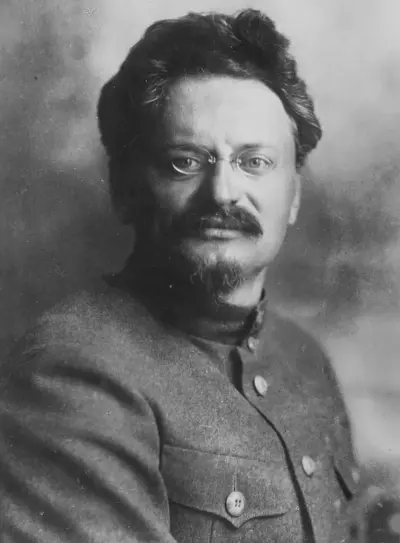
Lev Davidovich Bronstein, better known as Leon Trotsky (/ˈtrɒtski/), was a Russian Marxist revolutionary, political theorist and politician. Ideologically a communist, he developed a variant of Marxism which has become known as Trotskyism.
