Neil Gorsuch Quotes
It would be a very good thing for all involved - the country, an independent judiciary, and the Left itself - if liberals take a page from David von Drehle and their own judges of the New Deal era, kick their addiction to constitutional litigation, and return to their New Deal roots of trying to win elections rather than lawsuits.
Gorsuch, Neil. "Liberals'N'Lawsuits." National Review, 7 Feb. 2005.


The Roosevelt administration had stemmed the tide of Hoover’s Great Depression but the nation had not yet recovered. The New Deal measures, most of which would be considered fundamental to good government 50 years later was being constantly thwarted by a Supreme Court with a strong arch conservative majority headed by James McReynolds, a virulent, overt, anti-Semitic racist, who hated FDR—see {616652} and {585241}. The situation was to many like that which existed before the Civil War when the Court rendered the Dred Scott decision that so harmed the nation. Frankfurter, not then a Supreme Court Justice, urged Roosevelt to do something lest the American Public lose all respect for the Court and our Constitutional system and have the nation harmed by not allowing reforms like child labor laws to go through. The court actually ruled by a narrow majority that the government could not pass laws making it illegal for 11 year old children to work in coal mines or factories. FDR attempted to add more justices turning the majority into a majority—“packing the Supreme Court”, but that politically backfired. Some of the reforms never went through while others needed Constitutional Amendments like the end to Prohibition.


The dramatic thing about this quotation is that in public, the mantra of conservatives about the courts of America is that they make and change laws as opposed to just interpreting and clarifying the laws. They traditionally accuse judges who rule against their favorite positions as using the courts as an instrument of political and social change. Here a leading conservative federal jurist, who thereafter became a member of the Supreme Court, was acknowledging and advocating the courts as instruments for conservative social, economic, and political change.

Apparently the “faults and errors” of England and the United States in their constitutions were not so bad after all and it was Poland who subsequently had to rewrite and adopt new constitutions thereafter until 1997 when they seem to have adopted most of the “faults and errors.”

This quotation supports the concept of judicial interpretation of the Constitution in the light of new events or discoveries.

It is argued whether Scalia’s problem was that the Supreme Court was doing something new or radical or the country had changed. He had certainly lived through the greatest transformation of any society and culture on earth at a pace of change that far exceeds anything that has occurred before. Scalia is one who believes that the Constitution should not be interpreted in recognition of these changes, but should be immutable as it was written for the late 18th century. Most judges and legal scholars disagree and try to interpret the Constitution as the founders would have intended, knowing what we know, having the tools and powers we have, and facing the problems of the modern world. It represents a major legal and philosophical debate.


The Supreme Court had ruled several of the New Deal programs unconstitutional.
Cummings was arguing against a Constitutional amendment. His alternative led to Roosevelt's court packing schema.

In reference to the Supreme Court "packing" legislation proposed by President Roosevelt, Prof. Cushman wrote:

The comment was prompted by FDR’s attempt to “pack” the Supreme Court.

For the phrase the "The Constitution follows the flag," see the Democratic Party platform of 1900.


Amicus Curia is Latin for Friend of the Court. In the American legal system, in any appeal case any organization or individual may file a brief to the court even though they are not on either side. Some like Brest do not like these briefs because they are not for either side but just want to benefit the country and the society. Others think that these are the best brief’s because they consider the big picture and not the specific parties to the case.

Dodd observed that FDR expanded the power of the Presidency to deal with the emergency of the Great Depression, and like most Americans hoped that these measures would succeed. The Supreme Court limited some of the power expansion to the Executive Branch, but was the start of the huge Presidential power expansion that would continue through the Cold War and the War on Terror by Presidents of both parties.

Although Queen Victoria was modern and liberal in many respects, the idea of self-determination by majority vote was unthinkable and certainly undesirable for her. She was not opposed to lands and peoples changing empires and peoples per se. It was how the decision was made that was critical to her. Sovereigns had been buying, selling, and trading lands and peoples for centuries. And after wars, the winners would also reallocate the kingdoms of the loser. But the idea of a democratic plebiscite making the decision was unacceptable. To her and many others of the day, power struggles between factions, politicians, and sovereigns themselves would cause them to inflame the passions of the people and/or bribe the people to vote to change their allegiance. She saw popular but possibly unscrupulous politicians “blackmailing” kings and queens and if payments from the treasury would not be made, the politician would stir up a movement to transfer allegiance to another sovereign who might well be willing to pay.


The best examples are Social Security and Medicare.
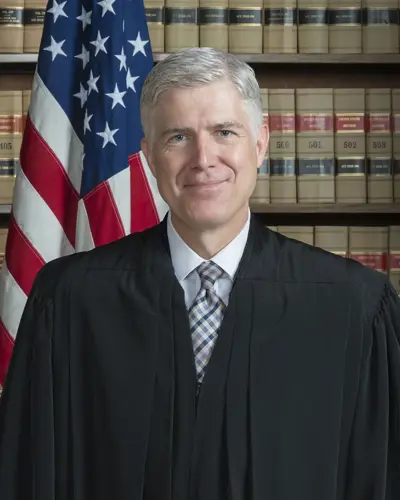
Neil McGill Gorsuch is an associate justice of the Supreme Court of the United States. He was nominated by President Donald Trump on January 31, 2017 and has served since April 10, 2017.
