Werner Heisenberg Quotes
It was about three o'clock at night when the final result of the calculation [which gave birth to quantum mechanics] lay before me ... At first I was deeply shaken ... I was so excited that I could not think of sleep. So I left the house ... and awaited the sunrise on top of a rock.
Heisenberg, Werner. Physics and Beyond: Encounters and Conversations. Translated by Arnold J. Pomerans, Harper & Row, 1971, p. 61.


The Higgs Boson was a fundamental particle of physics which controls much of what gives everything mass. At the time he coined the term, no one had ever seen or proved that a Higgs Boson even existed and he was trying to explain why searching for it was so important. The particle was proved to exist with the Super Hadron Collider in 2012. However scientists had some mathematical calculations that show that there should be 5 different Higgs Bosons. The search continued.

This is one of the most momentous quotations of all time. Otto Hahn was a German Chemist who until recently had worked with Lisa Meitner in one of the most productive scientific collaborations of all time. However, Meitner was Jewish and had to flee from Germany with Hahn’s help for her life. She went to Stockholm where they were doing almost no nuclear research and although she was a famous physicist, there was no laboratory or university that could use her talents, thus her term “empty handed”. She and Hahn had conducted a series of experiments bombarding radioactive material with particles which transmuted the radioactive element to another element nearby on the Periodic Table of the elements—an element with a close atomic number. After Meitner escaped, Hahn with Fritz Strassmann assisting, bombarded uranium the heaviest element with neutrons, the heaviest particles. However, in addition to the expected results, a substantial amount of Barium remained after the bombardment. Hahn was a brilliant experimental chemist and at first he assumed that perhaps they had identified the Barium erroneously or the data was read incorrectly, or the experiment had been contaminated. There was no explanation for it. So he sent copies of all the data to Meitner a brilliant Physicist and Mathematician who was the theoretician of their team. She studied the data with her nephew, Otto Frisch who was a young up and coming mathematician. After a few days, she had figured it out. Hahn had produced the first human induced case of nuclear fission although they gave it that name a little later. She and her nephew confirmed all the data readings mathematically and proved exactly what had happened. She refers to it in the letter as “splitting” the atom. She wrote to Hahn and explained what had happened. Without any intention of doing so, he and Strassmann were the first scientists to create a real example of nuclear fission. The world has never been the same since. Hahn and Strassmann were awarded the Nobel Prize.


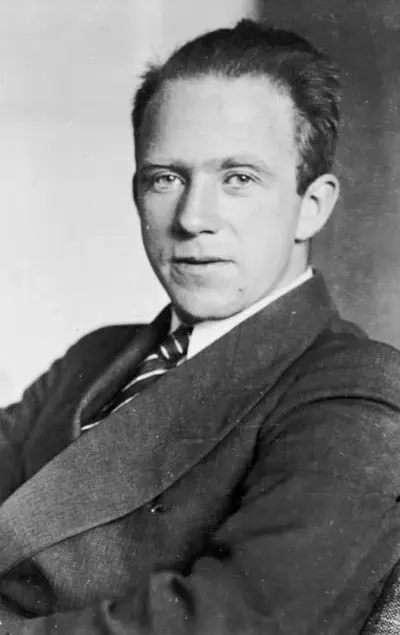
Werner Karl Heisenberg was a German theoretical physicist and one of the key pioneers of quantum mechanics. He published his work in 1925 in a breakthrough paper. In the subsequent series of papers with Max Born and Pascual Jordan, during the same year, this matrix formulation of quantum mechanics was substantially elaborated. He is known for the uncertainty principle, which he published in 1927. Heisenberg was awarded the 1932 Nobel Prize in Physics "for the creation of quantum mechanics".
