Paul Krugman Quotes
It should be possible to emphasize to students that the level of employment is a macroeconomic issue, depending in the short run on aggregate demand and depending in the long run on the natural rate of unemployment, with microeconomic policies like tariffs having little net effect. Trade policy should be debated in terms of its impact on efficiency, not in terms of phoney numbers about jobs created or lost.
Krugman, Paul. "What Should Undergrads Be Taught About Trade?" The American Economic Review, vol. 83, no. 2, May 1993, p. 24.

Although aggregate employment has remained relatively stable as global free trade has become the U. S. policy, there has been major employment disruption with some types of people benefiting and others like blue collar manufacturing workers having their entire careers wiped out. Port cities like Seattle, Baltimore have boomed while Midwestern manufacturing cities have deteriorated greatly.

This is a statement that in the early 21st century would be made only by ultra liberals. But in the in the late 1940’s this was not only standard democratic party thinking, but a large number of Republicans thought of the Government as the employer of last resort including their Presidential standard bearer.


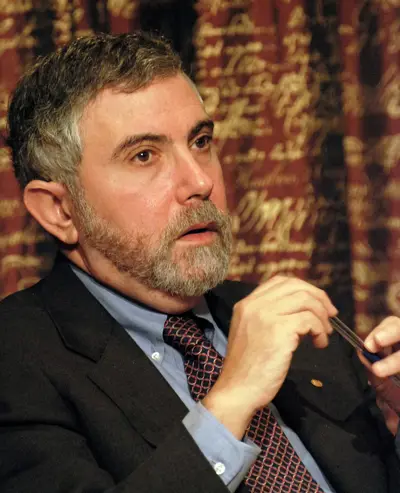
Paul Robin Krugman is an American economist who is the Distinguished Professor of Economics at the Graduate Center of the City University of New York, and a columnist for The New York Times. In 2008, Krugman was awarded the Nobel Memorial Prize in Economic Sciences for his contributions to New Trade Theory and New Economic Geography. The Prize Committee cited Krugman's work explaining the patterns of international trade and the geographic distribution of economic activity, by examining the effects of economies of scale and of consumer preferences for diverse goods and services.
