Aristotle Quotes
It must not be supposed that happiness will demand many or great possessions; for self-sufficiency does not depend on excessive abundance, nor does moral conduct, and it is possible to perform noble deeds even without being ruler of land and sea: one can do virtuous acts with quite moderate resources. This may be clearly observed in experience: private citizens do not seem to be less but more given to doing virtuous actions than princes and potentates. It is sufficient then if moderate resources are forthcoming; for a life of virtuous activity will be essentially a happy life.
Aristotle. The Nicomachean Ethics. Translated by H. Rackham, Harvard University Press, 1926, p. 623.


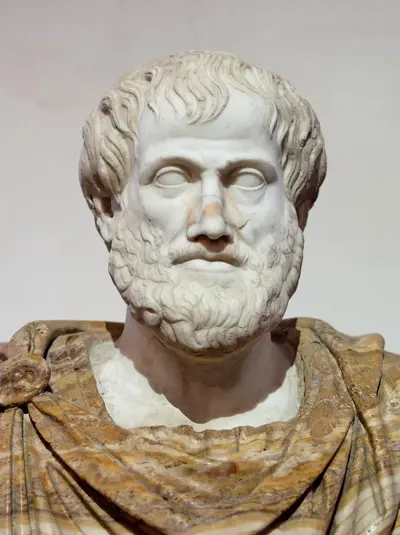
Aristotle (/ærɪˈstɒtəl/; Greek: Ἀριστοτέλης Aristotélēs, pronounced [aristotélɛːs]; 384–322 BC) was a Greek philosopher and polymath during the Classical period in Ancient Greece. Taught by Plato, he was the founder of the Lyceum, the Peripatetic school of philosophy, and the Aristotelian tradition. His writings cover many subjects including physics, biology, zoology, metaphysics, logic, ethics, aesthetics, poetry, theatre, music, rhetoric, psychology, linguistics, economics, politics, meteorology, geology and government. Aristotle provided a complex synthesis of the various philosophies existing prior to him. It was above all from his teachings that the West inherited its intellectual lexicon, as well as problems and methods of inquiry. As a result, his philosophy has exerted a unique influence on almost every form of knowledge in the West and it continues to be a subject of contemporary philosophical discussion.
