Joan of Arc Quotes
It is true I wished to escape; and so I wish still: is not this lawful for all prisoners?
Joan of Arc. The Trial of Joan of Arc. Translated by Daniel Hobbins, Harvard University Press, 2005, p. 57.


This law had an interesting unanticipated effect. Since most prisoners were assigned work outside the jail in different locations, there were not enough guards to watch them all so most reported to their work assignments as if they were going to a job and returned to the jail after work. The prisoners were paid wages by private employers and the first dollar a day they earned went to the State for their expenses. However, the prisoners got to keep the rest. The system seemed to work very well, however the crimes were relatively minor ones. In modern times, as a practical matter, almost no one gets jailed for these offenses any more.

He was trying to immigrate illegally to a number of countries and tried Beersheba in Israel which is in the desert—a climate with which he was familiar. With the Arab Israeli conflict ongoing, it is rare to get a description of the Israeli jails from someone who is not a party to the conflict.


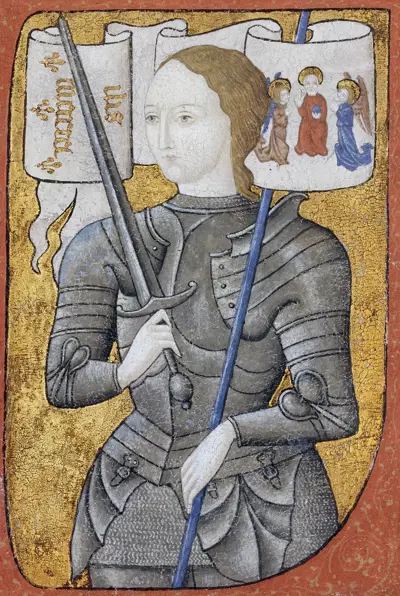
Joan of Arc, nicknamed "The Maid of Orléans" (French: La Pucelle d'Orléans) or "Maid of Lorraine" (French: La Pucelle de Lorraine), is considered a heroine of France for her role during the Lancastrian phase of the Hundred Years' War, and was canonized as a saint. She was born to Jacques d'Arc and Isabelle Romée, a peasant family, at Domrémy in the Vosges of northeast France. Joan said that she received visions of the archangel Michael, Saint Margaret, and Saint Catherine of Alexandria instructing her to support Charles VII and recover France from English domination late in the Hundred Years' War. The as-yet-unanointed King Charles VII sent Joan to the siege of Orléans as part of a relief army. She gained prominence after the siege was lifted only nine days later. Several additional swift victories led to Charles VII's consecration at Reims. This long-awaited event boosted French morale and paved the way for the final French victory at Castillon in 1453.
