Anthony Kennedy Quotes
It is proper that we acknowledge the overwhelming weight of international opinion against the juvenile death penalty.
This quotation produced an angry reaction by extreme conservatives. Some anti-intellectual conservatives feel that there should never be any consideration given in American Jurisprudence to any ideas, laws, practices, or even scientific studies emanating from foreign counties. This was especially offensive to them because the reference to foreigners was made in a case that involved capital punishment. Execution of juveniles is one of the factors that has prevented the U.S. Senate from ratifying the United Nations Treaty on the Rights of the Child after it has been signed and then endorsed by administrations of both major political parties. America has been a pioneer of children’s rights, but the two sticking points are capital punishment and the right of a parent to apply corporal punishment at parental discretion which are banned by the Treaty.
Anthony Kennedy, U.S. Supreme Court Justice, Roper v. Simmons, March 1, 2005
Sourced by: Eigen's Political and Historical Quotations

Kennedy, who had supported the Juvenile death penalty in a 1989 case, but by 2005 he had changed his mind and the court by a narrow 5-4 vote abolished the juvenile death penalty.


Einstein had changed his mind. He like almost everyone else at the time favored the death penalty, but in 1927 came to the new conclusion for the same reasons that many American politicians stated 70 years later. He had no compunctions against capital punishment for murderers who were dangers to society, but the potential error of the justice system led him to oppose state sanctioned execution. At the time the number of errors in capital cases that had been demonstrated were few. But as a scientist, Einstein knew that all human endeavors were prone to error. He was a strong law and order supporter however—see {588606}.

It is surprising that these ideas would come from one of the most autocratic powerful monarch in the world at the time. However there were many very liberal influences on her from Europe. This set of proposals she even sent to Voltaire to get his feedback and criticism. As late as 2006 the American President was reluctant to outlaw torture for terroristsand the Vice President actually argued for its retention as an interrogation technique. Over 300 years earlier the autocrat of Russia argued against it.

Major Fleener had been assigned to defend accused terrorists who were being held at the military prison in Guantanamo, Cuba. For several years they were held without a hearing or trial. Then the U. S. Supreme Court ruled that they had to be given a hearing or trial. A Military tribunal was selected. The methods and procedures of these hearings came under much public world-wide criticism as they did not meet the normal legal standards of most countries. Surprisingly, one of the military officers made public statements criticizing the army and the trials.


Roman law shaped European law for centuries. Even in the most dictatorial regimes of monarchies usually felt an obligation to avoid summary execution and have a trial, even if a crude, trumped up one involving torture of the accused. This Roman law had a long and profound influence.

The George W. Bush Administration attempted to avoid compliance with American Law and the Constitution by keeping captured terrorists in a Naval Base in Guantanamo, Cuba, and claiming that the American law did not there prevail. The Supreme Court twice ruled that the practices of the Administration in dealing with Terrorist prisoners violated the law and the Constitution. Meanwhile world public opinion was very opposed to the Bush Administration practices with captured war combatants which had never been attempted by any other administration. Finally President Bush in June of 2007 announced that Guantanamo would be closed.


The Senator was referring to the large number of people who had been exonerated by DNA evidence while on Death Row.

Several American soldiers have been court marshalled and found guilty of illegal torture for Warterboarding prisoners to induce them to provide information. Most experts agree that intelligence received this way is highly unreliable in that victims will say anything they think the torturer wants to hear to get the torture to stop.
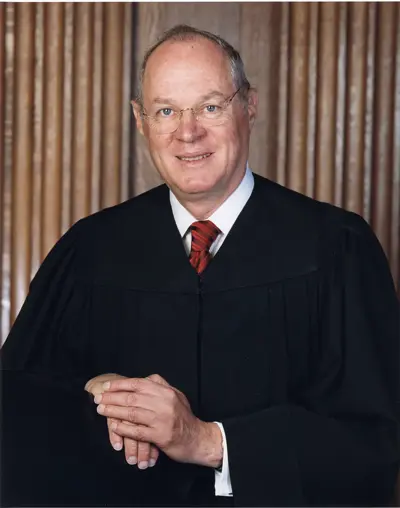
Anthony McLeod Kennedy is a retired American lawyer and jurist who served as an Associate Justice of the Supreme Court of the United States from 1988 until his retirement in 2018. He was nominated to the court in 1987 by President Ronald Reagan, and sworn in on February 18, 1988. After the retirement of Sandra Day O'Connor in 2006, he was the swing vote on many of the Roberts Court's 5–4 decisions.
