Gilbert K. Chesterton Quotes
It is not merely true that a creed unites men. Nay, a difference of creed unites men - so long as it is a clear difference. A boundary unites. Many a magnanimous Moslem and chivalrous Crusader must have been nearer to each other, because they were both dogmatists, than any two agnostics. "I say God is One," and "I say God is One but also Three," that is the beginning of a good quarrelsome, manly friendship.
Chesterton, G. K. "Our Note Book." The Illustrated London News, 10 Aug. 1907.


See {586039} for a quotation that goes further and seeks to punish and humiliate the non believers. This sura is often used by those wishing to illustrate the intolerance of Islam—especially of other religions. They fail to put this into the context of the Old Testament which proscribed death for heretics or the history of Christianity regarding the murder of nonbelievers. The difference is however, that a very small proportion of Jews or Christians today believe in following Biblical instructions in this respect while the proportion of Muslims who believe in the literal interpretation of scripture on these points is much larger. However there are Islamic modernists and moderates throughout the world who reject this notion of warring on all other religions and there is a struggle going on within Islam itself.

Different Christian European powers moved in and out of alliances with each other and with the Islamic Ottoman Empire. So Christians were not unified and whenever a Christian country was at war with the Muslims some Christians perceived it as an assault on Christianity—except that there were Christian allies of the Muslims. Later many Muslims would see any conflict with a Christian country as an attack in Islam even when Muslim nations were allied with the Christians as was Turkey at the end of the 20th century. Turkey was a member of NATO and was therefore seen as traitors to Islam by some Muslims. There has always been this tendency to see conflict in terms of religious or ethnic hostility where convenient.

At the time Turkey and the Ottoman Empire included Egypt and most of the Middle East, Chechnya, Georgia, Armenia, Usbekistan, Ajerbaijon, Greece, Albania, Serbia, Bosnia, Croatia and other countries.

While not in the Koran, this attributed statement is the basis for the ban on non-Muslims going on a Hajj and going to the most holy Muslim places—Mecca, Mina, Muzdalifa, and Arafat as well as the anti-religious hostility to all religions but Islam which is present in some Muslim countries.
In some countries political candidates run on religious platforms to convert the part of the population that is not of their religion and turn the nation into a theocracy.

Followers of the religious views of January Hus, 1369-1415 Hus was excommunicated and executed for his views that parts of the church were corrupt.

While it may be true that some major powers do not presently want unity between Muslims, the Sunni-Shiite conflict has been ongoing for centuries—long before many “major powers” even existed. It is the oldest, continual civil war in history. It is certainly true that major Islamic powers like Saudi Arabia oppose unity was Saudi Arabia is a Sunni majority country and regard the Shiites as not only blasphemous and evil, but see them as dangerous.


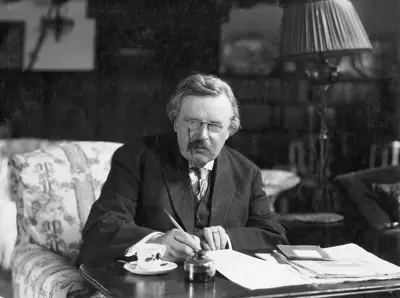
Gilbert Keith Chesterton KC*SG was an English writer, philosopher, lay theologian, and literary and art critic. He has been referred to as the "prince of paradox". Time magazine observed of his writing style: "Whenever possible Chesterton made his points with popular sayings, proverbs, allegories—first carefully turning them inside out."
