Anna Garlin Spencer Quotes
It is not alone the fact that women have generally had to spend most of their strength in caring for others that has handicapped them in individual effort; but also that they have almost universally had to care wholly for themselves
Spencer, Anna Garlin. Woman's Share in Social Culture. Mitchell Kennerley, 1912, p. 72.


Golden was one of the leading theater producers of the 1920s and 1930s. There is even a theater on Broadway named after him. This statement reflects a common attitude of the late 1930s of even many educated people. A few like Eleanor Roosevelt saw such a statement for what it was—ridiculous and responded publicly – {636785} . Note that for many years, this was a self-fulfilling statement. Producers like Golden thought women could not be great playwrights and therefore would never produce a play authored by a woman. Then others would use the fact that there were no even good plays that were written by female authors as evidence of the act that women could not be great playwrights.


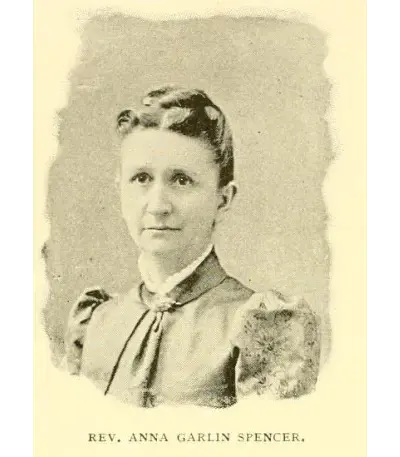
Anna Garlin Spencer was an American educator, feminist, and Unitarian minister. Born in Attleboro, MA, she married the Rev. William H. Spencer in 1878. She was a leader in the women's suffrage and peace movements. In 1891 she became the first woman ordained as a minister in the state of Rhode Island. In Providence she was commissioned to develop the Religious Society of Bell Street Chapel which was to be devoted to the religious outlook of James Eddy. She compiled Eddy's views into a Bond of Union to which members of the new society would subscribe. She was later associated with the New York Society for Ethical Culture (1903–1909) and the New York School of Philanthropy (1903–1913).In 1909, she signed on to the call to found the National Association for the Advancement of Colored People. Over a long period she was a popular lecturer and wrote on social problems, especially concerning women and family relations. Her writings include Woman's Share in Social Culture (1913) and The Family and Its Members (1922).
