Swami Vivekananda Quotes
It is clear to us that, for good or for evil, our vitality is concentrated in our religion. You cannot change it. You cannot destroy it and put in its place another.
Vivekananda, Swami. The Complete Works of Swami Vivekananda. Vol. 3. Advaita Ashrama, 1989, p. 289.


Note that this is a tribal right and not an individual one. When whites first came to America, the Iroquois, were the most sophisticated Native Americans. They were actually a confederation of 5 different tribes each of which was composed if many clans. Although fierce warriors, they had agreed not to fight each other and to assist if any were attacked. They developed a strong agricultural base, to go with the fishing and hunting, and their confederation were very aggressive and sophisticated traders taking them far from their upstate New York “capitol.” Their governmental structure was quite sophisticated with an elaborate, formal, system of checks and balances, multi-cameral legislatures that recognized numbers of citizens, power and wealth, and even cultural traditions. They were literate, capitalistic and globalistic in that they wanted to trade with all. They had written laws, and women had a role that was unique in world history in that only women owned property in a matrilineal society. Further, it was only the Clan Mothers who voted for the 50 Sachems (~Senators)—but their selections had to be accepted by the people they represented. Ironically the descendants of the Iroquois who remained in New York became a very successful Native American group. In the 2000 census, the average Indian in New York State earned the same income as the average White with no Indian gambling money.


This is a complaint similar to that made by anti-immigrant Americans. France, like most other countries of the world, has never had the large scale immigration of today, nor have they had such a large proportion of the same ethnicity at once—in this case, Muslim North Africans. There were never, before the last decades, enough immigrants of any ethnicity in France to have a choice of maintaining their traditional languages and culture and not learning French or otherwise assimilating. America, in contrast, had large immigrations of different ethnicities, and despite the erroneous beliefs of immigration opponents, these blocs of immigrants have wherever there was sufficient density—usually cities, they maintained their old language and other customs. However, their children and the next generation in almost all cases have abandoned the language and many of the customs of the old country. This was true of the Germans, the Irish, the Italians, the European Jews, the Russian Jews, the Scandinavians’, and the Hispanics with their different cultures.


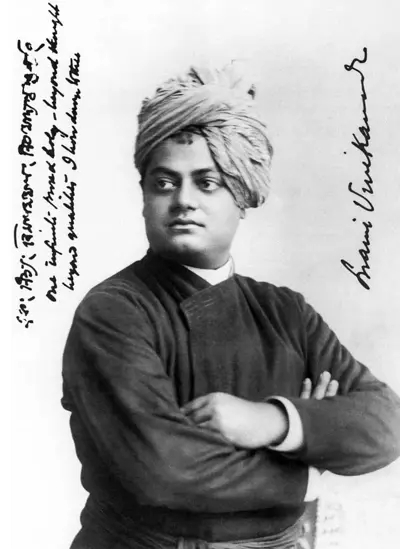
Swami Vivekananda, born Narendranath Datta (Bengali: [nɔrendronatʰ dɔto]), was an Indian Hindu monk. He was a chief disciple of the 19th-century Indian mystic Ramakrishna. He was a key figure in the introduction of the Indian philosophies of Vedanta and Yoga to the Western world, and is credited with raising interfaith awareness, bringing Hinduism to the status of a major world religion during the late 19th century. He was a major force in the contemporary Hindu reform movements in India, and contributed to the concept of nationalism in colonial India. Vivekananda founded the Ramakrishna Math and the Ramakrishna Mission. He is perhaps best known for his speech which began with the words "Sisters and brothers of America ...," in which he introduced Hinduism at the Parliament of the World's Religions in Chicago in 1893.
