Friedrich Nietzsche Quotes
It is certainly not the least charm of a theory that it is refutable; it is precisely thereby that it attracts the more subtle minds. It seems that the hundred-times-refuted theory of the "free will" owes its persistence to this charm alone; some one is always appearing who feels himself strong enough to refute it.
Nietzsche, Friedrich. Beyond Good and Evil. Translated by Walter Kaufmann, Vintage Books, 1966, p. 24.


Without free will, it would be futile for priests, ministers, rabbis or imams to preach morality to try and get people to behave in certain ways. The concept if sin and morality breaks down, and the clerics lost most of their power and influence. Cave was very concerned with the fact that a number of scientists were arguing that human behavior is caused by neurobiology, genetics and conditioning. They question whether an individual can be held accountable for his actions by the society that raised him, educated him, influenced him, and if the individual seemed aberrant relative to all that, it must be because of his particular neurology which enables him or prevents him from being influenced by the society, or allows him to be influenced by the "darker" aspects of society.


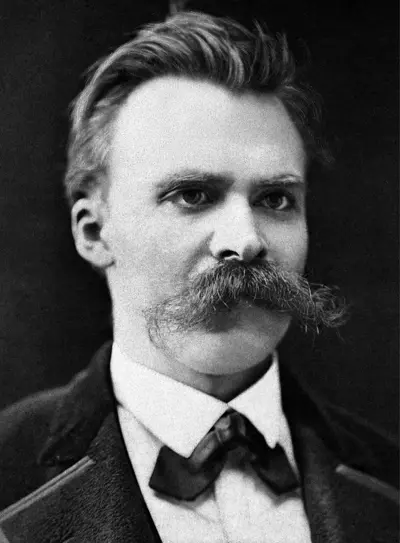
Friedrich Wilhelm Nietzsche was a German philosopher, cultural critic, composer, poet, writer, and philologist whose work has exerted a profound influence on modern intellectual history. He began his career as a classical philologist before turning to philosophy. He became the youngest person ever to hold the Chair of Classical Philology at the University of Basel in 1869 at the age of 24. Nietzsche resigned in 1879 due to health problems that plagued him most of his life; he completed much of his core writing in the following decade. In 1889, at age 44, he suffered a collapse and afterward a complete loss of his mental faculties. He lived his remaining years in the care of his mother until her death in 1897 and then with his sister Elisabeth Förster-Nietzsche. Nietzsche died in 1900.
