Emily Thornberry Quotes
It has always been the case that people on out-of-work benefits have to apply for more or less any job they can reasonably be expected to take. But the operative word there is 'reasonable,' because a job that's appropriate for a single, able bodied 22-year-old man may very well not be appropriate for a single mum who can't afford childcare.
Thornberry, Emily. Opinion piece on out-of-work benefits. HuffPost UK, AOL, 2013.


He wanted to condition long term unemployment insurance payments on the recipient taking training courses or other means of improving his/her skills and becoming more employable. He was opposed on the left by those who observed that this was insurance; the working nothing from the government; the worker had paid for it when he/she was working. It was his and was not conditioned on government requirement. The right wing opposed the idea as they had always wanted the out of work people to have little or no other opportunity than to take the worst and lowest paying jobs in the society. They also pointed out that if training was to be provided, it would cost more and not less. But Gingrich and his supporters on this idea observed that there were many jobs available even with the high unemployment rate; the unemployed workers just did not have the skills to do these jobs. Train them and unemployment would go down. The investment in unemployment insurance and training would pay off many times over.


Although this was one of his comic routines, he claimed it was true.
Forseth forgets that in Canada and the United States, as well as most other countries with equivalent systems, the individual worker pays into the Social Security Trust Fund and have paid for their insurance during their working career. Social Security has been solvent so no general welfare money has come into the system. Other conservatives complain that the yield that Social Security pays is not as large as it could be with a private investment and insurance option, so most conservatives do not even think of Social Security as a type of welfare.


This is one of the reasons that Denmark is referred to as a “Welfare State.”

Commenting on the British system to support people who cannot afford water and have water cut-off threatened:

There was no welfare and no Social Security then. Sinclair’s idea and another by a Physician by the name of Townsend (see {36007} ) were the only two ideas in the table about old age pensions. Franklin Delano Roosevelt, noting the appeal of Sinclair and the Townsend plan pushed Social Security shortly thereafter and it became law in 1936. This quotation illustrates that losing candidates and their programs can have a very profound effect on public policy.


Nixon’s view was very popular, except the reality of the welfare system was much more complicated than most people thought. A very large percentage of the adults on welfare were women with young children. There was no practical way for them to work unless there was some mechanism for caring for the children. Most of these women could only earn minimum wage which was not enough to cover the cost of child care. Providing child care would then cost more welfare money for this investment and politicians, even those hating the welfare system as it was, would not make this investment which would have dubious payoff. Training the women for better paying jobs and covering their child care in the process, works but the investment is very large and gives the government even more control of American life so there has never been a consensus for this. In other cases, women could get work but not having an automobile, they could not get to jobs in most of the United states. Further, requiring welfare recipients to work, collapsed when the economy was in recession. Many women just could not find jobs, and even when the government provided assistance, the state of the local economy determined whether or not workfare was practical.


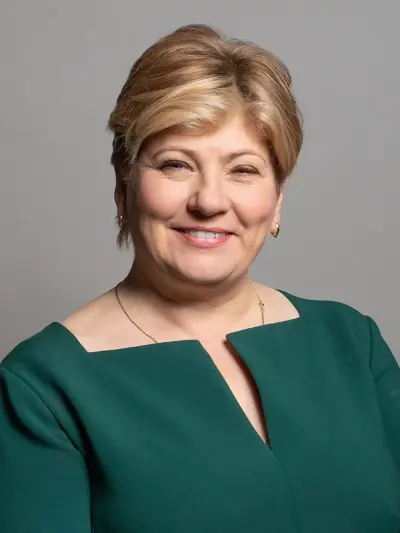
Emily Anne Thornberry is a British politician who has been the Member of Parliament (MP) for Islington South and Finsbury since 2005. A member of the Labour Party, she has served as Shadow Secretary of State for International Trade since 2020. She had previously served in the Shadow Cabinet of Jeremy Corbyn as Shadow First Secretary of State from 2017 to 2020 and Shadow Secretary of State for Foreign and Commonwealth Affairs from 2016 to 2020.
