William Rawle Quotes
It depends on the state itself to retain or abolish the principle of representation, because it depends on itself whether it will continue a member of the Union. To deny this right would be inconsistent with the principle on which all our political systems are founded, which is, that the people have in all cases, a right to determine how they will be governed. This right must be considered as an ingredient in the original composition of the general government, which, though not expressed, was mutually understood. . .
Rawle, William. A View of the Constitution of the United States of America. H.C. Carey & I. Lea, 1825, pp. 289-290.


Martin and other anti-Federalists argued against ratifying the new Constitution as they thought that it was inimical to the state’s interest. The notion of Federalism as a danger to states is clearly stated in this quotation for the debate on Constitutional ratification. Fundamentally, are Senators representatives of their states or of the Federal Government. If the former, who can the senators be recalled or impeached by the states to who the presumably owe their loyalty? This issue, like so many others, was compromised. The States would control the selection and method of selection of the Senators but could not recall or impeach. Looking back, we see this as logically inconsistent. However, looking at it as a political compromise between two legitimate points of view, it seems quite reasonable. Early America was a combination of idealism and pragmatism which has carried throughout American history.


Greene had a deep distrust of Congress from his wartime experiences regarding support of the troops. See {621971}.

His political view was one of general opposition to Government—especially large Government. However, even the Conservative voters whose nomination he sought did not elect him to any public position. His inherited fortune allowed him to run for office and campaign.


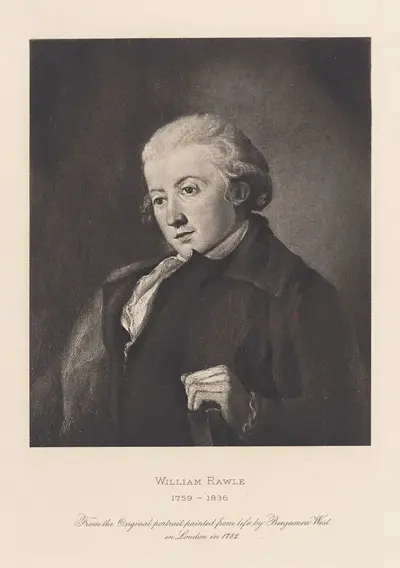
William Rawle was an American lawyer in Philadelphia, who in 1791 was appointed as United States district attorney in Pennsylvania. He was a founder and first president of the Historical Society of Pennsylvania, president of the Pennsylvania Abolition Society, and for 40 years a trustee of the University of Pennsylvania.
