Rutherford B. Hayes Quotes
It could be clearly proved that by a practical nullification [by the South] of the Fifteenth Amendment the Republicans have for several years been deprived of a majority in both the House and Senate. The failure of the South to faithfully observe the Fifteenth Amendment is the cause of the failure of all efforts towards complete pacification. It is on this hook that the bloody shirt now hangs.
Hayes, Rutherford B. Diary and Letters of Rutherford Birchard Hayes, Volume 3. Edited by Charles Richard Williams, Ohio State Archaeological and Historical Society, 1924.


In the beginning of the 21st century, many republican state legislatures attempted to change the voting laws to eliminate the possibility of voter fraud which was not a serious practical problem in America. However, a consequence—some argue indented and some argue unintended—was that it was harder for certain groups of people to meet the new requirements and therefore was a de facto voter suppression for some people such as the very elderly, the homeless, and the poor. Many of these efforts were declared unconstitutional by the courts.

Ironically, for 100 years after the Civil War, it was the Democrats who tried to keep the Blacks from voting as until Franklin and Eleanor Roosevelt began to attract Negro votes, Blacks voted overwhelmingly Republican. In 1964 President Johnson, with bipartisan support overcame the Southern Democratic Filibuster and passed the Civil Rights Act and then the Voting Rights Act. The Republican leadership, sensing the Southern Democratic Anger at the Democratic Party Leadership, implemented their Southern Strategy and embraced the most racist Southern Democrats if they would switch parties. Most did quickly. Soon, almost all the conservatives had abandoned the Democratic Party. This made the Republican Party more conservative and soon liberal Republicans were extinct and by the end or the 20th century, most of the moderates were gone. With almost all of the worst racists in the nation becoming Republicans and being warmly welcomed by the Republican leadership, almost all Blacks became Democratic voters. Then the racist conservatives went back to their time-tested mechanisms for suppressing the Black vote—only this time it was for the benefit of the Republican party. Soon the non-racist Republicans, realizing that minority voter suppression could be an effective mechanism to offset the greater minority fertility rate, the increased voting rate of the young, and the alienation of many unmarried women to the more conservative Republican ideology, got behind voter fraud prevention—a more acceptable purpose for activities that coincidently could make it more difficult for minorities to register and vote. Those activities were what Judge Debevoise was referring to in this quotation.


Preclearance was a requirement that any change in the voting or registration laws, rules or procedures needed to be approved by the Federal Justice Department.
He was explaining why preclearance was necessary. Preclearance was a requirement that any change in the voting or registration laws, rules or procedures needed to be approved by the Federal Justice Department.

Preclearance was a requirement that any change in the voting or registration laws, rules or procedures needed to be approved by the Federal Justice Department. He was testifying about why preclearance was important and why it was placed in the Voting Rights Act every time it was reauthorized. See {635271} for what happens without preclearance.
At the time Negroes were prohibited from voting by a series of discriminatory criteria for voter registration and intimidation so that Blacks would not generally even try to register. But the Civil Rights movement changed tactics and organized large scale attempts at voter registration. Mayor Thompson and the white power structure of the town were not going to allow that. They had not only enlarged the police department but the city purchased an a small armed tank.

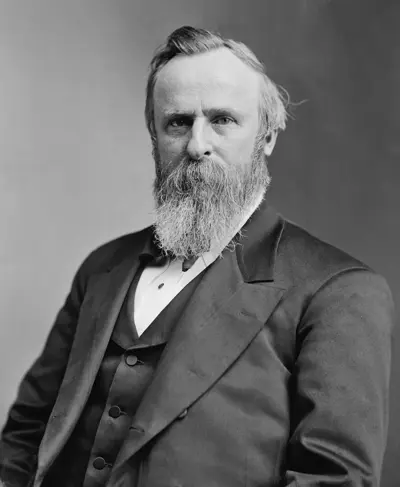
Rutherford Birchard Hayes was an American politician and attorney who served as the 19th president of the United States from 1877 to 1881, after serving in the U.S. House of Representatives and as governor of Ohio. A lawyer and staunch abolitionist, he had defended refugee slaves in court proceedings during the antebellum years. He negotiated the political agreement to end federal support of Reconstruction.
