Rosalyn Sussman Yalow Quotes
Initially, new ideas are rejected. Later they become dogma if you're right. And if you're really lucky, you can publish your rejections as part of your Nobel presentation.
Straus, Eugene. Rosalyn Yalow, Nobel Laureate: Her Life and Work in Medicine. Plenum Trade, 1998, p. 115.


While this is often true, it is another Mises exaggeration using the word “every” in this quotation. Darwin’s theory of evolution was immediately accepted by most other scientists and intellectuals. The opponents then were the religious fundamentalists. The same is true today. Einstein’s Theory of Relativity was accepted by most other scientist as soon as they read it and worked out the mathematics. That was before there was any physical or experimental evidence, which did not come till 1919.


He was referring to the institutions in the particular fields. An established institution in education like a university might develop an innovation in astronomy or language translation, but not likely develop significant innovations in education. An established computer programming company might innovate the method of warehousing and shipping merchandise, but they are not likely to develop an innovative way of computer programming. That is typically done by a programming non-established firm or individual. There are a number of exceptions and this is not put forth as a general principle, but as a statistical observation. Established institutions are working harder and smarter to find ways of innovating regularly, and may succeed more frequently than the present.


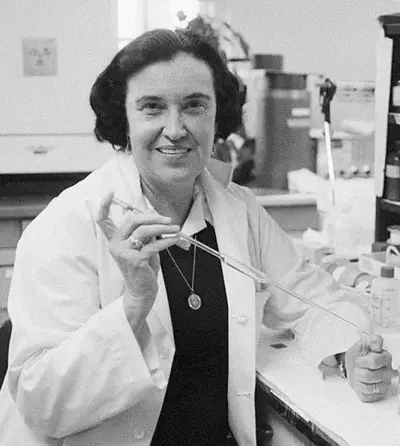
Rosalyn Sussman Yalow was an American medical physicist, and a co-winner of the 1977 Nobel Prize in Physiology or Medicine (together with Roger Guillemin and Andrew Schally) for development of the radioimmunoassay technique. She was the second woman (after Gerty Cori), and the first American-born woman, to be awarded the Nobel Prize in Physiology or Medicine.
