Nuremberg Tribunal Quotes
Individuals have international duties which transcend the national obligations of obedience ... Therefore individual citizens have the duty to violate domestic laws to prevent crimes against peace and humanity from occurring
Nuremberg Tribunal, International Tribunal which Tried the German WWII War Criminals, Nuremberg 1946
Sourced by: Eigen's Political and Historical Quotations


The United States Senate must ratify all treaties before they can become effective. The Senate has been very reluctant to ratify treaties where the U. S. government or any of its citizens could come under the jurisdiction of any legal entity which did not abide by all the rights citizens are guaranteed by the U. S. Constitution. As a result, we do not recognize the World Court and the Treaty of Rome for example. The latter is the one that gives the World Court jurisdiction over a high level official who commits war crimes even in his own country. The result is that many dictators who do not want to be constrained by international law, do not sign the treaty fending off any pressure to do so by pointing to the United States. But Rothkopf and others who agree with him have not yet been able to come up with a mechanism that will assure American Constitutional rights to Americans who might be involved with the World Court and allow the court to punish the dictators who abuse their own population. The French would like their laws and constitution to control. The Russians, theirs. The Chinese, theirs. Every American public official takes an oath to defend The Constitution. That is their primary duty. Foreign policy and punishing international war criminals must take a lower priority.


This statement was made before the 2012 Syrian Revolution.


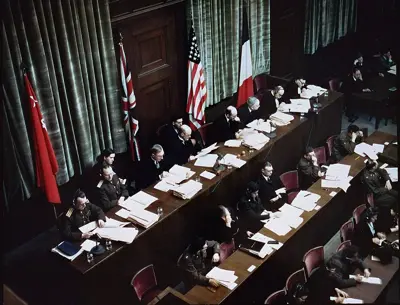
Coordinates: 49°27.2603′N 11°02.9103′E / 49.4543383°N 11.0485050°E / 49.4543383; 11.0485050 The Nuremberg trials were a series of military tribunals held by the Allied forces under international law and the laws of war after World War II. The trials were most notable for the prosecution of prominent members of the political, military, judicial and economic leadership of Nazi Germany, who planned, carried out, or otherwise participated in the Holocaust and other war crimes. The trials were held in the city of Nuremberg, Germany, and their decisions marked a turning point between classical and contemporary international law.
