Pius XII Quotes
Individual liberty, freed from all bonds and all laws, all objective and social values, is in reality only a death-dealing anarchy.
Pius XII, 1876-1958, [Eugenio Pacelli], Roman Catholic Pope, Address to the World Federal Government Movement, April 6, 1951
Sourced by: Eigen's Political and Historical Quotations


This is a very important quotation. It explains in great part, why there have been so few internal revolutions in Muslim countries. Al-Ghazi’s interpretation of Islamic Law and Theology concluded that even if the ruler is incompetent, corrupt, or destructive he should be supported and obeyed by all good Muslim citizens. The reason was that anarchy and/or chaos was an evil much worse for the Islamic community. There was one exception in the case of a ruler who was blasphemous or did not follow Islam. Then it was the duty of good Muslims. Since then, the ruler of an Islamic state, first seeks to ingratiated himself with the clergy. In Saudi Arabia, for example, the Royal Family gives enormous sums to all the clerics. They then urge dissidents and would be revolutionaries to accept the Royal Family with its flaws and shortcomings and accept their lack of freedom and human rights. And they tell all that the King and his family are all religious and support Islam. Therefore any revolt would be a tantamount to a sin. The Christian world had a different technique for inhibiting Revolution. Christian rulers claimed the Devine Right of Kings—that God had selected and ordained the king to lead. Regime change was contrary to the word of God. In a sense, the Islamic approach is more intellectually honest and seems to have worked much better than the Christians who have had so many revolutions. Better that is from the rulers point of view. From a democratic, Jeffersonian point of view revolting against an evil ruler was almost a moral obligation, and Al-Ghazali’s principle is all wrong and is keeping the Muslim countries from reaching democracy.


in the form of legislation For "everyone doing what is right in his own eyes", compare Judges 17:6
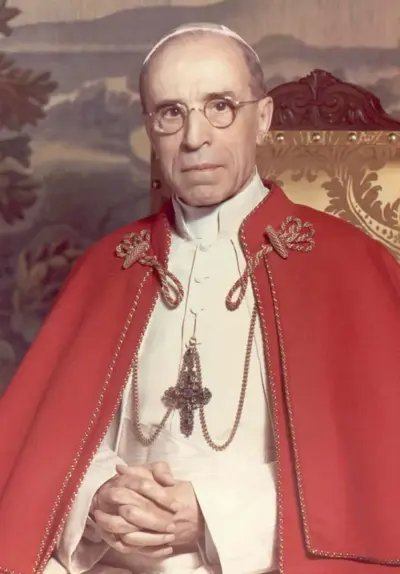
Eugenio Maria Giuseppe Giovanni Pacelli was born on 2 March 1876 in Rome into a family of intense Catholic piety with a history of ties to the papacy (the "Black Nobility"). His parents were Filippo Pacelli (1837–1916) and Virginia (née Graziosi) Pacelli (1844–1920). His grandfather, Marcantonio Pacelli, had been Under-Secretary in the Papal Ministry of Finances and then Secretary of the Interior under Pope Pius IX from 1851 to 1870 and helped found the Vatican's newspaper, L'Osservatore Romano in 1861. His cousin, Ernesto Pacelli, was a key financial advisor to Pope Leo XIII; his father, Filippo Pacelli, a Franciscan tertiary, was the dean of the Roman Rota; and his brother, Francesco Pacelli, became a lay canon lawyer and the legal advisor to Pope Pius XI, in which role he negotiated the Lateran Treaty in 1929 with Benito Mussolini, bringing an end to the Roman Question.
